

Welcome to our deep dive into Chapter 1. If you are looking for the full book breakdown, be sure to read our complete Atomic Habits Summary & Key Takeaways guide. The path to achieving extraordinary results is found through microscopic daily improvements rather than monumental shifts.
Society conditions us to believe that massive success requires massive, immediate action. We obsess over the defining moments of triumph instead of analyzing the decades of invisible work that fueled them. This comprehensive Atomic Habits Chapter 1 summary will aggressively dismantle everything you thought you knew about personal transformation.
You do not need to overhaul your entire life today to become a different person tomorrow. You simply need to optimize the tiny, seemingly insignificant choices you make hourly. James Clear proves that building a high-performance life does not require superhuman willpower or motivation.
The secret is mathematical and mechanical rather than emotional or motivational. Success is nothing more than the daily repetition of deeply ingrained routines over a long time horizon. When you learn how to manipulate these tiny routines, you bend the trajectory of your entire future.
Most professionals fail because they attempt to change too much, too quickly, and burn out within weeks. They treat personal growth like a sprint instead of acknowledging it as a lifelong marathon. This chapter provides the foundational blueprint for achieving mastery through the compounding power of microscopic habits.
You will learn why focusing on the finish line actually sabotages your progress. You will understand why the initial stages of any bold endeavor feel incredibly frustrating and empty. Ultimately, you will finish this guide equipped with a ruthless system for guaranteed daily growth.
Don’t have time to read? Listen to the full Atomic Habits audiobook for FREE with an Audible Trial.
The Core Theme of Chapter 1: The Atomic Habits Chapter 1 summary baseline
The fundamental premise of this opening chapter is unapologetically straightforward yet profound. Habits are the compound interest of self-improvement. In exactly the same way that money multiplies exponentially through compounding interest, the effects of your habits multiply as they are endlessly repeated.
A single good decision on a Tuesday barely registers on the grand scale of your life. Eating a solitary chicken salad will absolutely not make you a fitness model by Wednesday morning. Working late into the evening once will not magically transform your struggling startup into a unicorn enterprise.
However, when you repeat those microscopic good choices relentlessly, they alter your trajectory entirely. Your current reality is not a random accident or a stroke of bad luck. Your current outcomes are merely a lagging measure of your past daily habits.
Examine any aspect of your life and you will immediately see this lagging measure principle in absolute clarity. Your net worth is the lagging measure of your past financial routines and budgeting habits. Your physical health is the lagging measure of your past dietary choices and exercise routines over the previous five years.
Your current level of knowledge is the lagging measure of your past learning, reading, and studying habits. Even the clutter in your office is a lagging measure of your daily organizational habits. You are continuously getting exactly what you have systematically repeated.
Time magnifies the exact margin between success and failure in absolute terms. Time will endlessly multiply whatever behavioral inputs you feed into it every single day. Good habits make time your most powerful ally, while bad habits turn time into your most ruthless enemy.
Because these daily inputs are so small, we easily justify slipping up and breaking the chain. You eat a greasy burger instead of cooking because you figure that one bad meal cannot ruin your health. You skip the gym because you are tired, assuming that one missed workout will not instantly erode your muscles.
This is a devastating cognitive trap that keeps high-potential professionals trapped in mediocrity. When you repeat these 1 percent errors day after day, by rationalizing poor decisions, those toxic choices compound directly into terrifying results. What begins as a tiny, forgivable lapse transforms into a massive, life-altering failure down the road.
Key Takeaway 1: The Math of 1% Better Every Day
The strongest and most actionable mental model introduced here is the staggering math behind marginal gains. The concept of getting 1% better every day completely flips traditional success models upside down. If you can force yourself to improve by just one single percent each day for one year, the math is undeniable.
You will be roughly 37 times better by the time you reach the end of that 365-day cycle. Conversely, if you decline by just one percent every day for an entire year, you will decline nearly all the way down to absolute zero. What starts as a tiny win or a minor setback accumulates into something exponentially vastly larger.
Our brains naturally struggle to comprehend the sheer, terrifying power of exponential compounding. We operate on a linear expectation of reality, believing that effort should immediately parallel the reward. This is why we easily dismiss small changes because they do not seem to matter in the acute moment of execution.
You save ten dollars today, but you are obviously still not a millionaire by dinner time. You force yourself to practice a new language for twenty minutes, but you are still a complete novice. You read ten pages of a business book, but you are not suddenly a brilliant CEO.
The danger inside this phenomenon lies precisely in the total lack of immediate feedback or reward. Because you do not see the massive results instantly, you slide backward into your familiar, comfortable routines. Why run a mile today if your stomach looks exactly the same in the mirror tomorrow morning?
James Clear uses the famous example of British Cycling to demonstrate this aggressive 1% philosophy. The organization was utterly mediocre for decades, winning practically nothing on the world stage for nearly a century. They then hired Dave Brailsford, who introduced a relentless strategy he called “the aggregation of marginal gains.”
Brailsford and his coaches did not look for one massive, revolutionary breakthrough to fix the team. Instead, they ruthlessly searched for 1% improvements in every tiny area related to cycling performance. They redesigned bike seats for better comfort and rubbed alcohol on tires for better grip.
They went even deeper, testing different massage gels for optimal muscle recovery. They figured out the exact type of pillow and mattress that led to the best night of sleep for each athlete. They even painted the inside of their team truck white to spot tiny pieces of dust that would degrade the tuned race bikes.
As these hundreds of tiny 1% improvements aggressively accumulated, the results hit with terrifying speed. Just five years later, the British Cycling team completely dominated the 2008 Olympic Games, winning 60% of available gold medals. They had proven that the math behind compounding daily growth is absolutely unbreakable.
Key Takeaway 2: The Problem with Goal Setting
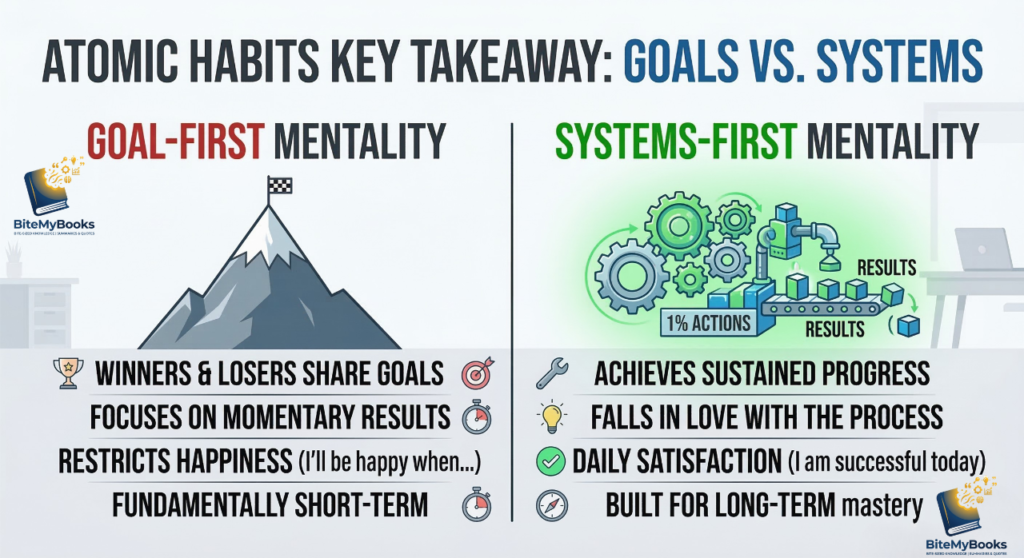
Modern corporate productivity culture is deeply, inextricably obsessed with setting massive, audacious goals. We are taught from a young age that the only way to achieve greatness in life is to set specific, highly actionable goals. Clear aggressively argues that this entire paradigm is fundamentally flawed and actively prevents us from succeeding.
We must radically shift our focus away from the overarching goals and pour our energy exclusively into our daily systems instead. You do not miraculously rise to the level of your lofty goals. You default directly down to the level of your implemented systems.
Here is exactly why optimizing systems vs goals is the only sustainable strategy for dominating your industry:
- Winners and losers share the exact same goals. Every single Olympian arriving at the starting block wants to win the gold medal. Every single entrepreneur competing in a market wants a spectacularly successful product launch. The goal itself does not differentiate the winner; the superior underlying system of daily, unglamorous practice separates them.
- Achieving a specific goal is merely a temporary, momentary change. Imagine your office is chaotically messy and you set a powerful goal to finally clean it up. If you summon the energy to clean it, you will have a spotless office for exactly one day. If you do not change the sloppy habits (the system) that caused the mess, your office will be a chaotic disaster again by next week.
- Goals aggressively restrict your daily happiness. A goals-first mentality infects your mind with the poisonous idea that “Once I reach my goal, then I am allowed to be happy.” Systems allow you to fall deeply in love with the actual process of growth. You experience profound satisfaction and happiness every single day simply by executing your intended daily routine.
- Goals are fundamentally at odds with long-term, sustained progress. The primary purpose of setting a goal is exclusively to win the game in the short term. The core purpose of building a system is to simply continue playing the game indefinitely. When you only focus on the goal, you immediately lose your motivation the very second the goal is actually achieved.
Goals are undeniably useful for setting an initial sense of direction and mapping a general course. However, systems are entirely responsible for making the actual, grueling progress required to get there. If you completely ignored your goals and focused solely on your daily system, you would still succeed wildly.
Key Takeaway 3: The Plateau of Latent Potential
The single greatest psychological barrier to creating any lasting, profound behavioral change is a misunderstanding of how progress actually works. The vast majority of people expect their daily efforts to yield immediate, overtly visible results. They expect progress to look like a perfectly straight, linear line aggressively climbing upward toward success.
In stark reality, early efforts in any new endeavor often yield absolutely zero visible payoff for a significant duration. James Clear expertly labels this deeply frustrating psychological trap the “Valley of Disappointment.” This is the exact, catastrophic moment when most people simply quit because they feel they are failing.
They endure grueling workouts in the gym for four consecutive weeks without the scale moving a single pound. They study complex coding for a month and still cannot build a functional, basic application. They conclude that their intense effort is defective, so they abandon the habit entirely just weeks before a breakthrough.
What these frustrated quitters violently fail to realize is that their intense work is never being wasted. Their effort is simply being meticulously stored up for later massive deployment. A breakthrough moment is often just the delayed release of weeks, months, or years of stored-up, invisible potential.
Clear uses the brilliant analogy of an ice cube sitting on a table in a freezing room to illustrate this concept. The room is 25 degrees, and you slowly begin heating it up, degree by excruciating degree. You heat the room to 26, 27, 28, 29 degrees, and the ice cube does absolutely nothing.
You hit 30, then 31 degrees, and the ice cube still sits completely frozen, mocking your aggressive heating efforts. Then, the room hits exactly 32 degrees, and the ice cube immediately begins to melt rapidly into a puddle. A single, seemingly invisible one-degree shift finally unlocked all the latent potential stored during the previous heating stages.
All of your previous efforts from 25 degrees to 31 degrees were not wasted or futile in any way. That stored energy was the absolute prerequisite required to eventually cross the 32-degree melting threshold. Complaining about not achieving success after a week of hard work is like complaining that the ice did not melt at 29 degrees.
Mastery absolutely demands an aggressive, unyielding patience that most professionals simply refuse to cultivate. The most powerful, enduring outcomes in life are invariably delayed well beyond what our impatient minds want to tolerate.
Chapter 1 Bite-Sized Action Plan
Stop obsessing endlessly over the finish line and immediately build a microscopic 1% system today. Information without rapid, decisive execution is completely worthless to your career and personal growth. You must turn these psychological concepts into an aggressive, unyielding daily action.
Identify one massive, daunting goal that you are currently struggling violently to achieve in your professional life. Completely, totally ignore the existence of that overarching goal for the next 24 consecutive hours. Do not visualize the finish line, do not map out the next year, and do not buy new software to track it.
Instead, ruthlessly force yourself to write down exactly one microscopic habit you can execute today that moves you 1% forward. Execute that single, highly specific action immediately right now. Do not wait until tomorrow morning or next Monday; perform the microscopic action today and officially begin compounding your potential.
Chapter 1 FAQ
What is the main idea of Chapter 1 in Atomic Habits?
The main idea is that tiny habits are the compound interest of all self-improvement and personal growth. By stubbornly focusing on getting just 1% better every single day, tiny changes accumulate into massive, earth-shattering transformations over time. Massive success is ultimately derived from building better daily systems, not from setting larger, more audacious goals.
What does James Clear mean by the “Valley of Disappointment”?
The “Valley of Disappointment” is the highly painful early phase of building a habit where you exert intense effort but see zero visible results. Because actual human progress is exponential rather than linear, your initial efforts are simply being stored, not wasted at all. Impatient people often quit in this agonizing valley just moments before their stored potential is finally unlocked and realized.