
📋 Chapter 2 at a Glance
- Core Idea: Identity drives behavior — not the other way around.
- Key Framework: Three Layers of Behavior Change (Outcomes → Processes → Identity).
- The Shift: Move from outcome-based habits to identity-based habits.
- The Method: Every small action is a “vote” cast for who you are becoming.
This Atomic Habits Chapter 2 summary covers one of the most important mindset shifts in the entire book — and arguably in all of personal development. James Clear argues that lasting behavior change is not about what you want to achieve. It is about who you believe you are.
For a complete overview of the entire book, check out our Atomic Habits Summary & Key Takeaways guide. If you missed the mathematical breakdown of getting 1% better every day, read our Atomic Habits Chapter 1 Summary first.
Chapter 2 is titled “How Your Habits Shape Your Identity (and Vice Versa).” It is the philosophical backbone of the entire Atomic Habits system. Let’s break it down.
📌 Jump To
- The Three Layers of Behavior Change
- Outcome-Based vs. Identity-Based Habits
- The Two-Step Process to Changing Your Identity
- Chapter 2 Bite-Sized Action Plan
- Chapter 2 FAQ
The Three Layers of Behavior Change
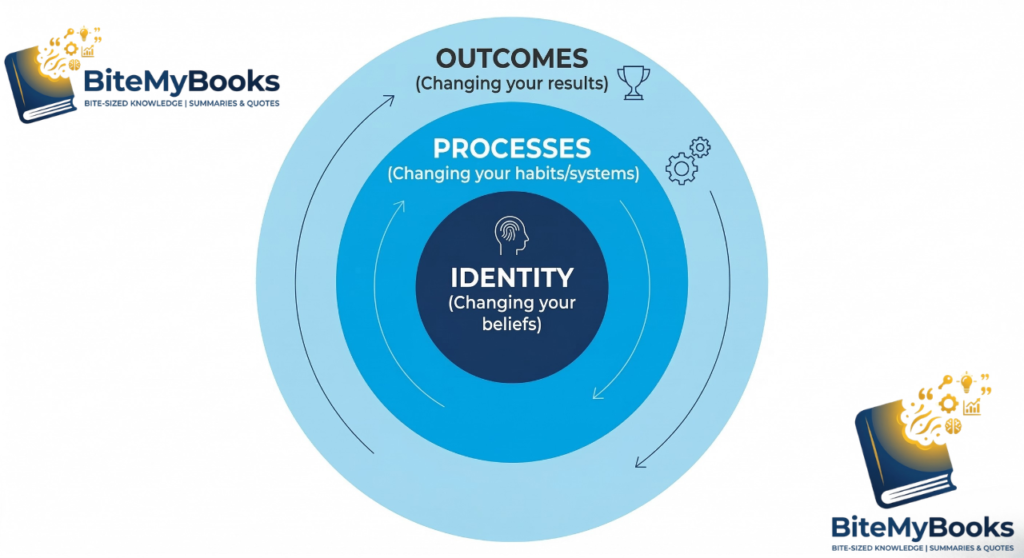
James Clear opens Chapter 2 with a powerful model: behavior change happens at three distinct levels, visualized as concentric circles — like the rings of an onion.
Most people start from the outside and work inward. Clear argues the most effective people do the exact opposite.
Layer 1: Outcomes (The Outermost Ring)
This layer is about changing your results — losing weight, publishing a book, winning a championship. Most goals you set live here. Outcomes are what you get.
Layer 2: Processes (The Middle Ring)
This layer is about changing your habits and systems — starting a new workout routine, decluttering your desk, developing a daily meditation practice. Most habits you build operate here. Processes are what you do.
Layer 3: Identity (The Innermost Ring)
This is the deepest layer. It is about changing your beliefs — your worldview, your self-image, and your judgments about yourself and others. Identity is what you believe.
💡 The Key Insight: Outcomes-first thinking asks “What do I want to achieve?” Identity-first thinking asks “Who do I want to become?” The direction you start from completely determines whether change sticks.
The problem with focusing solely on outcomes is simple: you can achieve a goal and still revert to your old behavior the moment the pressure is gone. Identity-based change creates a permanent foundation.
Outcome-Based vs. Identity-Based Habits
Clear illustrates the difference with one of the most memorable examples in the book: the smoker.
Imagine two people being offered a cigarette. Both want to quit smoking. Here is how each responds:
- Person A (Outcome-Based): “No thanks. I’m trying to quit smoking.”
- Person B (Identity-Based): “No thanks. I’m not a smoker.”
The difference is enormous. Person A is fighting against their current identity. Person B has already adopted a new one. One response signals struggle; the other signals a settled self-concept.
This is not just semantics. The words you use to describe yourself — even silently, in your own head — shape the decisions you make every single day. Behind every system of action is a system of beliefs.
| Outcome-Based Thinking | Identity-Based Thinking |
|---|---|
| “I want to run a marathon.” | “I am a runner.” |
| “I’m trying to eat healthier.” | “I am someone who fuels my body well.” |
| “I’m working on reading more.” | “I am a reader.” |
| “I’m trying to quit smoking.” | “I am not a smoker.” |
This chapter is packed with profound insights. You can read the best Atomic Habits Quotes on Identity in our dedicated collection — they are worth revisiting every single week.
The Two-Step Process to Changing Your Identity
Here is where Clear gets intensely practical. Identity change is not a lightning-bolt moment. It is a slow accumulation of evidence.
He introduces the idea of habits as “votes” cast for the type of person you want to become. Every time you go to the gym, you cast a vote for the identity of “someone who is fit.” Every time you write a page, you cast a vote for “writer.” No single vote wins the election — but a consistent pattern of votes does.
Step 1: Decide Who You Want to Be
Start with your values and your principles. Ask yourself two pointed questions:
- What kind of person do I want to be?
- What would a person like that do today?
You do not need a perfectly mapped-out plan. You just need a clear direction. “I want to be the kind of person who never misses a workout” is enough to start.
Step 2: Prove It With Small Wins
This is where habits become the mechanism of change. Each small action you take — no matter how minor — is a piece of evidence supporting your new identity.
- Meditate for 2 minutes → evidence that you are “someone who meditates.”
- Write one sentence → evidence that you are “a writer.”
- Do one push-up → evidence that you are “an athlete.”
Clear is explicit: you do not need to do big things. You need to do consistent things. The goal is not to hit a certain number of votes — it is to build an unshakeable belief in yourself through repeated action.
🔑 The Identity Loop: Your habits shape your identity. Your identity shapes your habits. The loop is self-reinforcing — for better or worse. Start casting votes for who you want to be, and the identity follows.
This also reframes failure brilliantly. Missing one workout does not make you “not a runner.” It is a single lost vote in a long election. What matters is the overall tally — and whether your identity belief remains intact.
Chapter 2 Bite-Sized Action Plan
Reading this chapter without acting on it is the fastest way to forget it. Here is your one specific task for today:
🎯 Your Identity Vote — Do This Today
- Choose one identity you want to build (e.g., “I am a reader,” “I am someone who exercises daily,” “I am productive in the mornings”).
- Write it down in the present tense, on paper or your phone’s notes app.
- Cast one vote for that identity right now. Read one page. Do five push-ups. Spend five minutes on your most important task.
- Repeat tomorrow. One vote at a time.
That is it. You are not trying to transform your life today. You are trying to build evidence. The transformation is the sum of those daily votes, compounded over months and years.
Chapter 2 FAQ
What is the main point of Chapter 2 in Atomic Habits?
The main point of Chapter 2 is that lasting behavior change must start with identity, not outcomes. James Clear argues that instead of focusing on what you want to achieve, you should focus on who you want to become. Small, consistent habits then serve as the evidence that reinforces that new identity.
What is an identity-based habit?
An identity-based habit is a behavior rooted in a belief about who you are, rather than what you want to get. Instead of running to “lose weight” (an outcome), you run because “I am a runner” (an identity). The habit becomes an expression of self — which makes it dramatically more durable than willpower or motivation alone.
The Bottom Line on Chapter 2
Chapter 2 of Atomic Habits delivers the single most important reframe in the book: you do not rise to the level of your goals — you fall to the level of your identity.
Stop asking what you want. Start asking who you want to be. Then cast one small vote for that person today. And tomorrow. And the day after that.
Ready to keep going? Read our Atomic Habits Chapter 3 Summary next — where Clear introduces the Four Laws of Behavior Change and the habit loop that drives everything.