📋 Chapter 4 at a Glance
- Core Idea: Before you can build new habits, you must become aware of your current ones.
- The Problem: The brain automates behavior to save energy, meaning our worst habits happen subconsciously.
- The Method: Pointing-and-Calling forces automatic behaviors back into conscious awareness.
- The Tool: The Habits Scorecard helps you objectively inventory and score your daily actions.
A seasoned paramedic attends a family gathering and immediately notices something is terribly wrong with her father-in-law. She insists he go to the hospital exactly that moment, completely ignoring his protests that he feels perfectly fine. Hours later, he undergoes life-saving surgery for a massive, catastrophic heart blockage.
How did she know? Her brain had subconsciously processed subtle changes in his facial coloring, a skill she acquired over years of intense medical experience. This is the sheer power of subconscious pattern recognition. As we repeat behaviors, our brain learns to automate them to save mental energy, whether we consciously want to or not.
Welcome to our definitive Atomic Habits Chapter 4 summary. This chapter focuses on the 1st Law of Behavior Change (Make it Obvious). If you don’t know the four laws yet, read our Atomic Habits Chapter 3 Summary to learn the 4-step habit loop.
Before you can build life-changing systems, you must first recognize the invisible routines currently running your life. For a complete roadmap of James Clear’s systems, bookmark our ultimate Atomic Habits Summary & Key Takeaways guide.
📌 Jump To
The Danger of Subconscious Habits
The human brain is an ultimate efficiency machine continually striving to save physical and mental energy. When you encounter a new situation, your brain works incredibly hard to analyze it and decide on an appropriate action. However, once you repeat an action enough times, conscious thought completely vanishes.
Habits quickly become permanent reflexes. You no longer think about tying your shoes, locking your front door, or turning off the lights when leaving a room. The brain simply outsources these actions to the basal ganglia, freeing up cognitive space for more complex problems.
This biological efficiency is fantastic for basic survival but utterly devastating for personal growth. You cannot change a behavior if you are entirely blind to its existence. Your absolute worst habits happen when you are operating strictly on autopilot.
💡 The Key Insight: The first step to replacing a bad habit is quite simply acknowledging it happens at all. You have to shock your conscious brain awake and observe your own daily life from an objective, third-party perspective.
- Awareness always precedes change: You must recognize a habit before you can alter it. You cannot fix what you cannot actively measure.
- Autopilot is the ultimate enemy of growth: Mindless repetition reinforces destructive behaviors just as effectively as positive ones.
- The brain heavily protects your routines: Because thinking consumes vast amounts of energy, your brain will actively fight to keep your current negative habits automated.
The Pointing-and-Calling Method
To combat the overwhelming danger of automatic behavior, James Clear introduces the Japanese railway system’s brilliant safety protocol known as Shisa Kanko (Pointing-and-Calling). The Japanese railway is globally renowned for being one of the safest and most punctual transit systems in the entire world.
Every single train conductor, platform worker, and maintenance crew member rigorously uses this system. When a conductor approaches a signal, they physically point at it and forcefully call out its status aloud. “Signal is green!” This incredibly simple physical and verbal action significantly reduces devastating errors.
Why does this work so remarkably well? Pointing and calling forces the brain to aggressively transition from a subconscious state to a conscious one. It requires physical movement, active visual attention, and verbal auditory processing occurring simultaneously. You literally cannot point and call mindlessly.
You can apply this exact same methodology to your own life to catch bad habits before they permanently derail your progress. By literally stating your intentions aloud, you rob the negative habit of its automatic, silent power.
- The junk food reflex: Before eating a cookie, point at it and say, “I am about to eat this cookie, but I know I don’t need it, and it will destroy my caloric deficit today.”
- The procrastination reflex: When opening social media, say, “I am opening this app to waste valuable time instead of finishing my critical quarterly report.”
- The spending reflex: When making an impulse purchase, state aloud, “I am buying this useless item even though it directly violates my strict monthly budget.”
- The snooze reflex: When your alarm goes off, say aloud, “I am hitting snooze, which means I am actively choosing to start my day stressed and rushed.”
How to Create Your Habits Scorecard
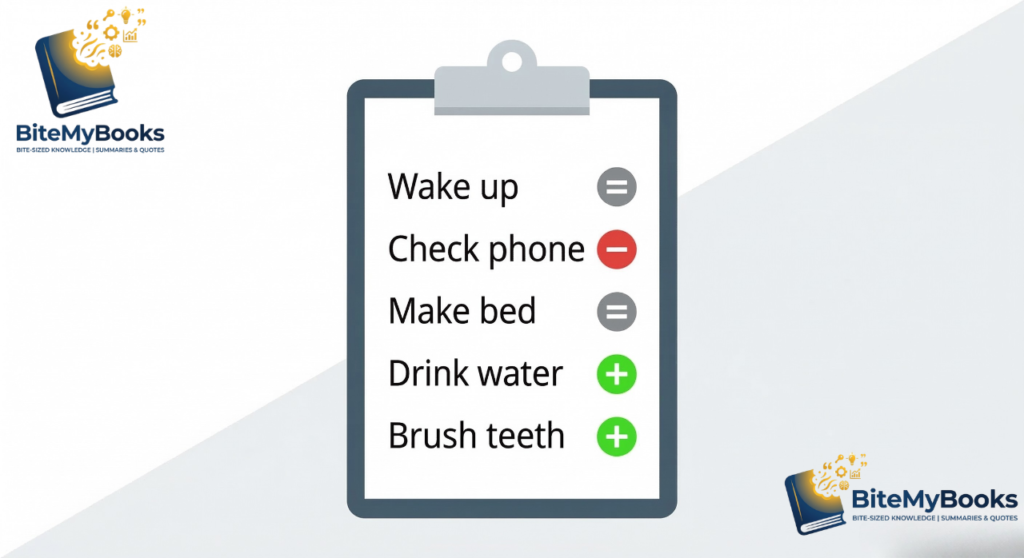
If you genuinely want to transform your life and career, you need a precise inventory of your current operating system. James Clear explicitly designed the Habits Scorecard for this exact daily purpose. It is a terrifyingly accurate mirror reflecting how you actually spend your days, not how you falsely think you spend them.
The process is incredibly straightforward but requires total, ruthless honesty. You write down everything you do from the split second you wake up to the moment you go to sleep. You record your actions strictly chronologically, leaving absolutely nothing out.
| Symbol | Habit Assessment |
|---|---|
| + (Positive) | Behaviors that consistently cast votes for the exact type of person you want to become. |
| – (Negative) | Behaviors that actively pull you away from your ultimate goals. |
| = (Neutral) | Necessary daily functions that neither help nor hurt your ultimate trajectory. |
The Golden Rule of the Scorecard: Do not judge yourself while making this incredibly important list. Your only job is to become an unbiased, clinical observer of your own life.
You are acting strictly as an auditor, simply recording raw data. Do not beat yourself up over the negative marks. Guilt is an emotional response, and heavy emotions rapidly cloud rational observation. This is not a vicious indictment of your character; it is merely a clinical assessment of your behavior.
🔑 The Ultimate Question: If you are struggling to categorize a specific habit, ask yourself: “Does this active behavior help me become the exact type of person I desperately wish to be?” A habit is positive only if it powerfully reinforces your desired identity.
Chapter 4 Bite-Sized Action Plan
Mindlessly reading about the Habits Scorecard is entirely useless unless you aggressively execute the strategy. We demand relentless action from our readers at BiteMyBooks. Right now, today, you are going to take the critical first step toward total behavioral awareness.
🎯 Your Accountability Task — Do This Today
- Track the micro-habits. What is the very first thing you do when you open your eyes? Write it down immediately.
- Follow the physical path. Where do you physically walk next? Document every single room transition.
- Note your consumption. What is the absolute first thing that enters your body or your mind?
- Score the list mercilessly. Apply the ‘+’, ‘-‘, and ‘=’ symbols to everything you wrote down based strictly on your long-term goals.
- Identify the exact trigger points. Look closely at the negative habits. What happened immediately before you executed the bad behavior? That specific moment is your cue.
Total awareness is the absolute foundation of permanent change. You simply cannot optimize a complex behavioral system you do not completely understand. By isolating just the first two hours of your day, you will quickly uncover dozens of automated behaviors you never consciously chose to adopt.
Chapter 4 FAQ
What is the main lesson in Chapter 4 of Atomic Habits?
The main lesson of Chapter 4 is that behavioral change strictly requires deep conscious awareness. Because our brains efficiently automate repeated actions to save energy, our worst habits predictably happen completely on autopilot. You must deliberately use powerful tools like Pointing-and-Calling or the Habits Scorecard to aggressively drag these subconscious routines into the harsh light.
How does the Habits Scorecard work?
The Habits Scorecard is a completely objective, highly effective daily inventory system. You ruthlessly write down every single action you take chronologically throughout the day. You then aggressively categorize each habit as positive (+), negative (-), or neutral (=) based entirely on whether it objectively helps you become the specific type of person you wish to be.