
📋 Chapter 7 at a Glance
- Core Idea: Self-control is a short-term strategy, not a long-term solution. Willpower depletes quickly.
- The Myth: “Disciplined” people have heroic willpower. The Truth: They simply spend less time in tempting situations.
- The Science: Your brain suffers from “cue-induced wanting.” Seeing the trigger immediately revives the craving.
- The Inversion of the 1st Law: To break a bad habit, you must Make It Invisible. Remove the cue entirely.
Most of us falsely believe that overcoming bad habits requires an unbreakable, iron-clad sense of discipline. We mistakenly think that success is about aggressively white-knuckling our way through immense temptation every single day. The actual truth is far simpler and significantly more forgiving. Welcome to our definitive Atomic Habits Chapter 7 summary, where we completely expose the fatal myth of willpower.
People with remarkably high self-control do not possess magical genetics or superior moral character. They simply understand one crucial fact: they intentionally engineer their lives to spend significantly less time in tempting situations. By actively removing the negative triggers from their daily environment, they almost never have to forcefully use their willpower.
For a complete blueprint on building good habits and breaking bad ones, bookmark our ultimate Atomic Habits Summary & Key Takeaways guide. In the previous chapter, we learned how to add good triggers to our spaces. If you missed it, read our Atomic Habits Chapter 6 Summary on Environment Design.
📌 Jump To
Why Willpower is Not Enough
Society constantly preaches that achieving success is strictly a matter of exerting sheer, brute-force willpower. We are falsely taught that if we just “try harder,” we can mysteriously resist every single toxic urge that attacks us. This strategy is a guaranteed recipe for total exhaustion and inevitable failure. Willpower is a heavily finite resource that rapidly drains throughout your busy day.
Riding the “white-knuckle” train of willpower completely drains your mental and physical energy. When you are stressed, tired, or emotionally overwhelmed, your heroic discipline vanishes instantly. You cannot sustainably fight your environment every single minute of your life. Eventually, the intense friction will violently break your resolve.
Self-control is incredibly effective as a short-term emergency strategy, not a long-term lifestyle solution. You might successfully resist eating a modern processed donut one singular time. However, if that donut sits maliciously on your desk all week, you will inevitably surrender and eat it.
💡 The Key Insight: Stop trying to become a mythical superhero of discipline. Start becoming the genius architect of your physical environment.
- Discipline is deeply fragile: Even the most highly focused individuals fail when continuously bombarded by negative triggers.
- Resistance breeds harsh fatigue: Constantly fighting your own desires literally exhausts your brain’s cognitive bandwidth.
- Play a fundamentally different game: Do not desperately try to resist the temptation; completely eliminate the temptation from your sight.
Cue-Induced Wanting (How the Brain Gets Hijacked)
Your brain is biologically hardwired to relentlessly scan your environment for rewarding opportunities. When you repeatedly execute a bad habit, your brain permanently maps a specific visual cue to an intense dopamine reward. This devastating psychological mechanism is widely known as cue-induced wanting. You can successfully break a bad habit, but you are highly unlikely to ever chemically forget it.
Once a powerful habit is fiercely formed, the sudden appearance of the cue triggers an aggressive, almost involuntary craving. If a former smoker unexpectedly sees a pack of cigarettes sitting on a table, the biological craving violently returns instantly. The cue aggressively hijacks the brain before conscious logic can intervene.
This is precisely why attempting to quietly “ignore” a bad habit while remaining fully exposed to its triggers is impossible. The cue forcefully commands your attention and actively generates a severe physical urge. To kill the craving, you must ruthlessly kill the cue.
| The Flawed Approach | The Brain’s Reaction | The Ultimate Outcome |
|---|---|---|
| Keeping junk food visible but “trying” not to eat it. | Cue-induced wanting immediately spikes dopamine and triggers fierce cravings. | Willpower inevitably crumbles. You eat the junk food. |
| Throwing the junk food completely in the outside trash. | The intense visual cue is entirely removed. No dopamine spike occurs. | Zero willpower required. The bad habit remains effectively dormant. |
The Inversion of the 1st Law: Make It Invisible
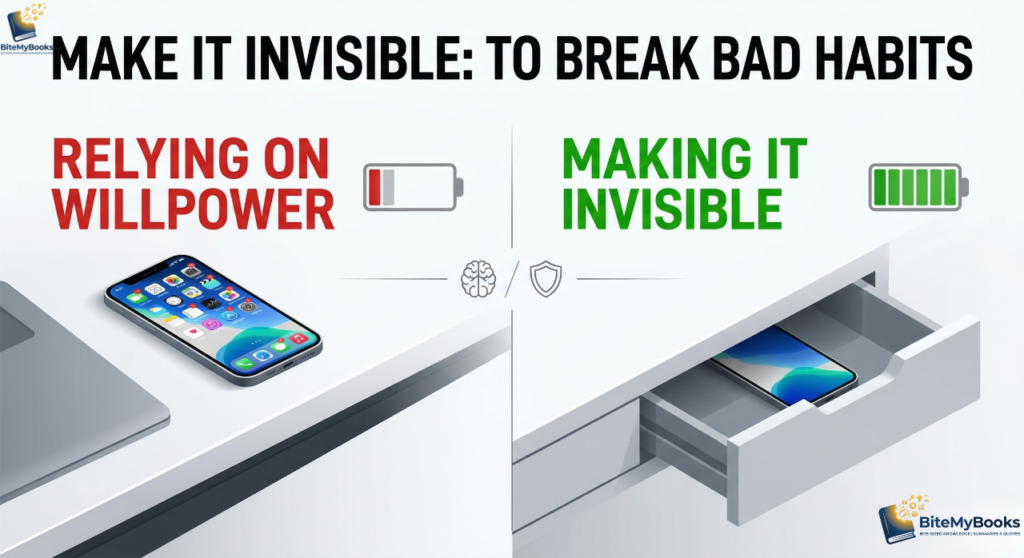
If the definitive First Law of Behavior Change for building a good habit is to “Make It Obvious,” then the ruthless counter-strategy is brilliantly simple. The absolute ultimate rule for breaking devastating bad habits is the exact Inversion of the 1st Law: Make It Invisible. You must aggressively strip your daily environment of the specific cues that spark your destructive behaviors.
You cannot comfortably negotiate with fierce biological cravings. You must entirely remove the root visual trigger from your immediate surroundings. When the primary cue is made completely invisible, the corresponding bad habit slowly starves and dies.
Here are three highly actionable examples of radically making your bad habits invisible today:
- If you continuously waste time scrolling on your distracting phone: Aggressively leave it charging in a completely different room during your deep work hours.
- If you constantly eat too much terrible junk food: Stop idiotically buying it at the grocery store so it legally cannot enter your private house.
- If you dangerously play video games when you should be studying: Physically unplug the heavy console and forcefully hide it inside your darkest closet after every single use.
By intentionally increasing the massive physical friction, you actively protect your fragile future self from your impulsive present self. Making the toxic cue thoroughly invisible is the highest form of personal self-care.
Chapter 7 Bite-Sized Action Plan
Knowledge without immediate ruthless execution is entirely useless. At BiteMyBooks, we strictly demand rapid, aggressive action. You possess zero excuses for continuously allowing terrible habits to violently dictate your precious life.
🎯 Your Accountability Task — Destroy the Cue Tonight
- Pick your most annoying bad habit right now. Brutally identify the one specific behavior that is currently destroying your daily productivity or health.
- Identify the precise visual cue that violently triggers it. Determine exactly what physical object or digital notification forcefully sparks your aggressive craving.
- Completely hide or destroy that cue tonight. Do not wait until tomorrow morning to casually negotiate. Ruthlessly remove the object from your visual field immediately.
You are entirely in control of your personal domain. Stop stubbornly relying on an exhausting, fabricated sense of discipline. Actively manage your physical cues, fiercely protect your attention, and you will fundamentally conquer your worst behaviors.
Chapter 7 FAQ
What is the main point of Chapter 7 in Atomic Habits?
The main point is that sheer willpower is deeply unreliable and heavily finite. The most disciplined individuals simply spend drastically less time in deeply tempting environments. To achieve massive self-control, you must prioritize radically redesigning your daily surroundings.
How does James Clear say to break a bad habit?
James Clear explicitly states that you must use the Inversion of the 1st Law: Make It Invisible. You aggressively break bad habits by completely removing the specific visual cues that suddenly spark your intense cravings. If the dangerous trigger is thoroughly hidden, the destructive behavior effortlessly starves.