📋 Chapter 8 at a Glance
- Core Idea: The 2nd Law of Behavior Change is Make It Attractive. The more desirable a habit feels, the more likely you are to stick with it.
- The Science: Dopamine spikes in anticipation of a reward — not just from receiving it. That anticipation is what drives you to act.
- The Strategy: Temptation Bundling — pair something you want to do with something you need to do.
- The Formula: After [CURRENT HABIT], I will [HABIT I NEED]. After [HABIT I NEED], I will [HABIT I WANT].
What if building good habits wasn’t a painful grind, but something you actually looked forward to? That is the bold promise at the heart of this Atomic Habits Chapter 8 summary. James Clear introduces the 2nd Law of Behavior Change: Make It Attractive — a powerful framework that rewires how you associate pleasure with the habits you need most.
For a complete blueprint on James Clear’s entire system, bookmark our ultimate Atomic Habits Summary & Key Takeaways guide. In the previous chapter, we covered how to break bad routines. Read our Atomic Habits Chapter 7 Summary to learn why willpower always fails.
The core insight of Chapter 8 is startlingly simple: you don’t need more willpower — you need better associations. When a habit feels attractive, your brain stops fighting it. This chapter shows you exactly how to engineer that feeling on demand.
📌 Jump To
The Role of Dopamine in Habit Formation
Your brain runs on dopamine. It is the neurochemical that signals reward, pleasure, and motivation. Every habit you have ever built — good or bad — was shaped by dopamine telling your brain: “That felt good. Do it again.”
Here is the critical distinction that James Clear highlights: dopamine does not just spike when you receive a reward — it spikes in anticipation of one. The craving itself, the moment of wanting, is when dopamine surges most powerfully. This is what compels you to take action in the first place.
Think about how you feel on the morning of a vacation. The excitement before you even leave the house is often more intense than the trip itself. Your brain is designed to want, not just to have. This is the loop Clear wants you to exploit.
💡 Key Science: Researchers found that blocking dopamine didn’t eliminate the ability to feel pleasure — it eliminated the motivation to pursue it. Dopamine drives desire, and desire drives behavior.
- Anticipation is the engine: The spike in dopamine happens before the reward, not after. This is what triggers action.
- Craving precedes every habit: No craving, no habit. Boost the craving and you boost the habit automatically.
- You can engineer desire: By associating habits with things you already crave, you make them neurologically irresistible.
This is how the brain’s reward system can be deliberately hacked. Clear’s strategy — temptation bundling — does exactly that.
What is Temptation Bundling?
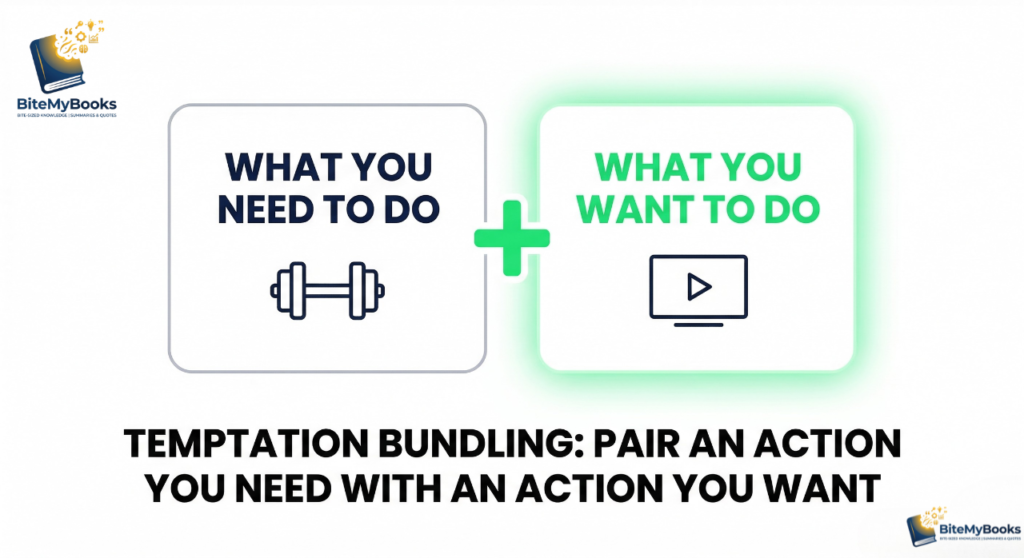
Temptation bundling is the practice of pairing a habit you want to do with a habit you need to do. You link a pleasurable activity directly to a productive one. The result: your brain begins to associate the productive habit with positive anticipation.
The concept was first formally studied by behavioral economist Katy Milkman at the University of Pennsylvania. But the real-world proof came from a remarkable engineering student named Ronan Byrne. Byrne hacked his stationary exercise bike so that Netflix would only play if he pedaled at a fast enough pace. No pedaling? No show.
The outcome was predictable in the best possible way: Byrne exercised consistently and eagerly. He had made a habit he needed (exercise) inseparable from a habit he wanted (watching Netflix). His brain stopped associating the bike with effort and started associating it with entertainment.
| Without Temptation Bundling | With Temptation Bundling |
|---|---|
| Exercise feels like a chore. You avoid it. | Exercise = your favorite show. You look forward to it. |
| Studying feels boring. You procrastinate. | Studying + great coffee = a ritual you enjoy starting. |
| Work tasks feel draining. Motivation collapses. | Work tasks bundled with a reward feel purposeful. |
The key psychological mechanism is this: your brain stops evaluating the “need” habit in isolation. It can no longer think about exercise without also thinking about the show. The two are fused at a neurological level.
The Temptation Bundling Formula
James Clear gives you a precise, repeatable formula for implementing temptation bundling in your own life. It is elegantly simple and immediately actionable. Here it is:
📐 The Temptation Bundling Formula
- After [CURRENT HABIT], I will [HABIT I NEED].
- After [HABIT I NEED], I will [HABIT I WANT].
You anchor your behavior to existing habits so there is zero friction about when to start. Then you lock the desirable activity immediately after the one you have been avoiding. The reward becomes the incentive to complete the need.
Here is a relatable, everyday example:
- After I pour my morning coffee (Current Habit), I will check and respond to my most important emails (Habit I Need).
- After I check my emails (Habit I Need), I will scroll Instagram for 10 minutes (Habit I Want).
The result? You no longer dread checking email. Your brain learns that completing that necessary task unlocks the enjoyable one. The “want” habits become earned rewards that make the “need” habits non-negotiable.
Here are more powerful examples you can steal today:
- After I sit down at my desk (Current Habit), I will write 250 words on my project (Need). After I write 250 words, I will make my favorite specialty coffee (Want).
- After I lace up my shoes (Current Habit), I will do my 20-minute workout (Need). After my workout, I will listen to my favorite podcast chapter (Want).
- After dinner (Current Habit), I will read 10 pages of a non-fiction book (Need). After I read, I will watch one episode of my series (Want).
Notice the structure: the want never comes before the need. This sequencing is critical. If you consume the reward first, there is no motivation left to complete the productive habit.
Chapter 8 Bite-Sized Action Plan
Knowledge without execution is just entertainment. At BiteMyBooks, we demand you take one ruthless action right now. No waiting until Monday. No writing vague goals in a notebook you will never open again.
🎯 Your Accountability Task — Build Your First Bundle Today
- Identify one guilty pleasure right now. Pick something you already do every day for fun — a specific TV show, a great cup of coffee, a playlist, social media, a podcast — anything that genuinely excites you.
- Identify the one hard task you have been avoiding. This is the habit you know you need to build — exercise, deep work, reading, meal prepping — whatever you keep procrastinating on.
- Write your bundle using the formula and lock it in today. Physically write it down: “After [Current Habit], I will [Need]. After [Need], I will [Want].” Do not modify the order. Execute it today — not tomorrow.
The goal is not perfection. The goal is one successful repetition that rewires the association in your brain. Every time you follow the sequence, you strengthen the neurological link between effort and pleasure. Over time, the habit you “needed” starts to feel as natural as the habit you “wanted.”
Stop waiting to feel motivated. Design the motivation into the system itself. That is exactly what James Clear teaches in Chapter 8, and it works.
Chapter 8 FAQ
What is the main point of Atomic Habits Chapter 8?
The main point of Atomic Habits Chapter 8 is the 2nd Law of Behavior Change: Make It Attractive. James Clear explains that habits stick when they feel desirable, and that dopamine — which spikes in anticipation of a reward — is the neurological engine that drives all behavior. By making habits feel irresistible through strategies like temptation bundling, you eliminate the need for willpower entirely.
What is temptation bundling?
Temptation bundling is the strategy of pairing a habit you want to do with a habit you need to do. You only allow yourself to enjoy the pleasurable activity after completing the productive one. This creates a powerful dopamine-driven association that makes necessary habits feel genuinely appealing rather than painful.