
This Atomic Habits Chapter 9 summary covers one of the most psychologically powerful ideas in James Clear’s entire book: your social environment is silently programming your habits every single day.
Humans are herd animals. We don’t build our behaviors in a vacuum — we absorb the habits, norms, and expectations of the people around us, often without even noticing it’s happening.
Before diving in, two resources worth bookmarking: For a complete blueprint of every rule in the book, bookmark our ultimate Atomic Habits Summary & Key Takeaways guide. And in the last chapter, we learned how to make hard tasks feel irresistible — read our Atomic Habits Chapter 8 Summary to master temptation bundling.
- Your habits are heavily shaped by the people you surround yourself with.
- We imitate 3 groups: the Close, the Many, and the Powerful.
- The ultimate hack: join a culture where your desired behavior is already the norm.
- Belonging to a group supercharges your motivation to stick with new habits.
The Hidden Power of Culture
Here’s a truth most people miss: you didn’t choose most of your habits. Your culture chose them for you.
Every tribe — whether a family, a city, a company, or a country — has a set of unspoken rules about how people behave. Those rules get absorbed simply by being in that environment long enough.
The bottom line? The most attractive behavior in any situation is the one that is considered “normal” by the people around you. Culture is invisible, but its pull on your actions is enormous.
- We copy behaviors that earn us approval, respect, and belonging.
- We avoid behaviors that lead to rejection or social exclusion.
- This happens automatically — it’s not a conscious decision, it’s human wiring.
James Clear’s argument is simple but profound: if you want to understand why you do what you do, look at the people you spend the most time with. Your environment is not just physical — it’s social.
1. We Imitate the Close (Family and Friends)
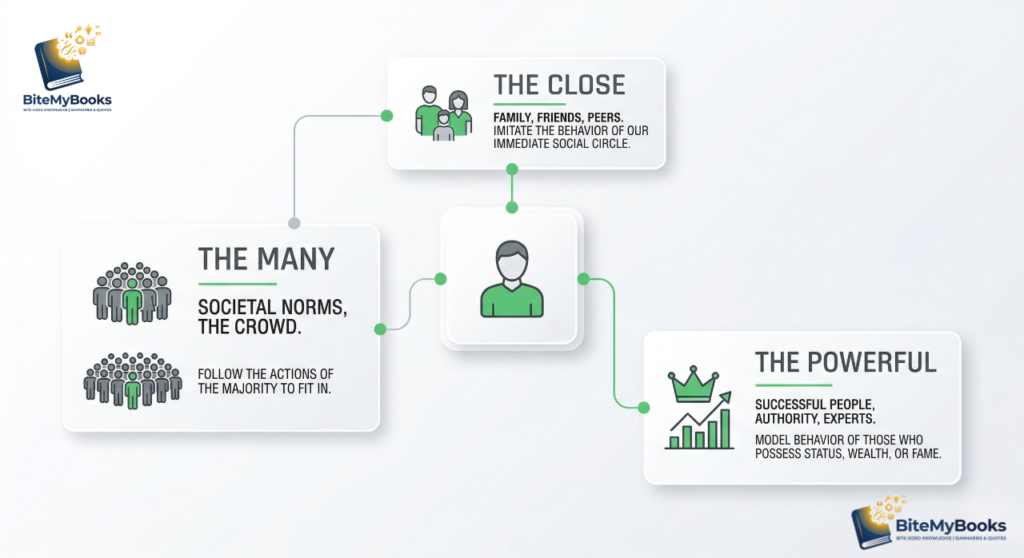
Proximity is destiny. The habits of the people physically closest to us leak into our own behavior — their vocabulary, their diets, their sleeping schedules, their work ethic.
You’ve heard the famous Jim Rohn quote: “You are the average of the five people you spend the most time with.” James Clear backs this up with research. Studies show that obesity, smoking, and even happiness spread through social networks like a contagion.
This isn’t about blame — it’s about awareness. The people in your innermost circle are your most powerful habit designers, whether you’ve chosen them intentionally or not.
- If your friends eat well → you’ll likely eat better.
- If your family watches 4 hours of TV a night → that becomes your baseline normal.
- If your colleagues hustle → you’ll naturally work harder without even noticing.
The takeaway: Audit your inner circle. It’s not about cutting people off — it’s about being deliberate about who you spend the most hours with each week.
2. We Imitate the Many (The Tribe)
When we’re unsure what to do, we don’t think for ourselves — we look at what everyone else is doing and copy it. This is herd mentality, and it’s not a weakness. It’s a deeply rational survival strategy.
Historically, being cast out of the tribe meant death. No food, no shelter, no protection. The human brain evolved to prioritize belonging above almost everything else, including our own independent judgment.
This is why social proof is so powerful in marketing, politics, and everyday life — and in your habits.
- Everyone at the gym is lifting heavy → you push harder without anyone telling you to.
- Everyone in the office orders salad → you skip the burger even if you wanted it.
- Your book club reads 2 books a month → reading becomes automatic, not forced.
The group creates a gravitational pull. When the tribe’s standard is high, your standard rises automatically. When the tribe’s standard is low, even motivated individuals eventually drift down to meet it.
“Humans are herd animals. We want to fit in, to bond with others, and to earn the respect and approval of our peers.” — James Clear, Atomic Habits
3. We Imitate the Powerful (Status and Prestige)
Beyond our close friends and our wider tribe, there’s a third group we copy: the successful, the prestigious, the respected.
We are wired to care about status. Status in the ancestral environment meant better access to food, mates, and safety. That wiring hasn’t disappeared — it’s just been redirected.
Today it shows up in how we model the routines of high-achievers:
- We wake up at 5 AM because CEOs and athletes say they do.
- We cold plunge because elite performers swear by it.
- We read voraciously because every successful person on every podcast says reading changed their life.
This isn’t inherently bad — it’s a powerful shortcut. Copying the habits of people who already have the results you want is one of the fastest paths to results. The key is to choose your role models deliberately rather than absorbing them passively from social media.
Ask yourself: Am I imitating people whose outcomes I actually want? Or am I copying whoever has the most followers?
Chapter 9 Bite-Sized Action Plan
All of Chapter 9 points to one powerful, strategic conclusion:
🏆 The Ultimate Habit Hack: Join a culture where your desired behavior is already the normal behavior.
Most people try to build habits alone, relying on willpower. That’s fighting against your social wiring. The smarter move is to change your social environment so the group pulls you in the direction you want to go.
Practical examples:
- Want to run more? Join a local running club. When your Saturday morning run crew texts you at 6 AM, you’ll show up every time.
- Want to read more? Join a book club or an online reading community. The social pressure makes you follow through.
- Want to eat healthier? Start cooking with friends who already eat well instead of modifying your diet alone.
- Want to lift consistently? Find a workout partner whose baseline gym attendance is higher than yours.
- Want to build a business? Join a mastermind group of founders who are already building.
The habit you want becomes easy when it’s what the people around you simply do. No motivation required. No willpower needed. The culture carries you.
James Clear frames it this way: belonging to a group gives your habit a built-in identity. You’re not just a person trying to run — you’re a runner. The group membership makes the identity stick.
How to Apply This Starting Today
- Identify the ONE habit you most want to build right now.
- Find or join a group where that behavior is the expected norm — in person, online, or both.
- Show up consistently and let the group’s culture do the heavy lifting.
That’s it. Three steps. No complex system required. Environment design — including your social environment — is the lever that makes everything else easier.
Chapter 9 FAQ
What is the main lesson of Atomic Habits Chapter 9?
The main lesson is that your habits are not invented in isolation — they are inherited from your social environment. The behavior your tribe considers “normal” becomes your default behavior. To change your habits effectively, change the culture you surround yourself with, because belonging to a group where your desired habit is standard makes it far easier to stick with.
Whose habits do we imitate the most?
According to James Clear, we imitate three distinct groups: the Close (family and close friends whose daily behaviors we absorb through proximity), the Many (the wider tribe whose norms we default to when uncertain), and the Powerful (high-status, successful individuals whose routines we copy in hopes of achieving similar results). Of the three, our innermost circle — the 5 or so people we see most — has the deepest influence on our day-to-day behavior.