
Warren Buffett is widely considered the greatest investor of all time. We obsess over his stock picks, his reading habits, and his folksy Omaha wisdom. But we completely and utterly miss the actual secret to his success.
The truth is breathtakingly simple: Warren Buffett is not just a good investor; he has been investing relentlessly for three-quarters of a century. It’s not just about finding the right businesses to buy. It is the sheer, unstoppable force of confounding compounding.
This mathematical reality is one of the core tenets of Morgan Housel’s book. For a full breakdown of his financial rules, read our ultimate The Psychology of Money Summary & Key Takeaways guide.
If you are investing just to look rich to other people, you will fail. Read our breakdown of the Man in the Car Paradox to understand why wealth is actually what you don’t see.
Most investors spend their entire lives chasing the highest possible returns this year. They want rapid gains to fund a lavish lifestyle today. True wealth, however, is built quietly over decades by simply refusing to interrupt the magic of compound interest.
- Warren Buffett’s actual secret isn’t picking stocks; it’s the fact he has invested for 75 years.
- Our brains struggle with exponential math, causing us to abandon compounding far too early.
- Good investing is about “pretty good” sustainable returns, not highly leveraged catastrophic risks.
- The absolute hardest and most vital financial skill is doing nothing during market panics.
The Math Behind Warren Buffett’s Fortune
Let’s look at the brutal, undeniable math behind Buffett’s net worth. As of his early 90s, Warren Buffett was worth roughly $100 billion. Here is the fact that should change your entire financial perspective:
Over $80 billion of that net worth was accumulated after his 65th birthday. Read that sentence again.
Buffett started investing at age 10. By age 30, he had a net worth of $1 million—an incredible achievement. But if he had retired at 60 like a normal person, you would have never heard his name. He would simply be a wealthy guy playing golf in Nebraska.
The vast majority of his wealth did not come from being a market genius in his 20s. It came from being a good investor in his 20s and then doing nothing but compounding that money for the next 70 years. The math works fundamentally because of time, not just rate of return.
- Buffett’s average annual return is roughly 22%. Outstanding, but not unprecedented.
- Jim Simons, head of Renaissance Technologies, compounded money at 66% annually.
- Yet Buffett is significantly wealthier than Simons. Why? Because Simons didn’t find his investment stride until he was 50. Buffett started at age 10.
- Time, not just high returns, is the ultimate lever in wealth creation.
Compounding is a difficult, unintuitive force. It creates back-loaded returns. The biggest gains occur at the very end of the timeline, completely dwarfing the early years.
Why Our Brains Misunderstand Compounding
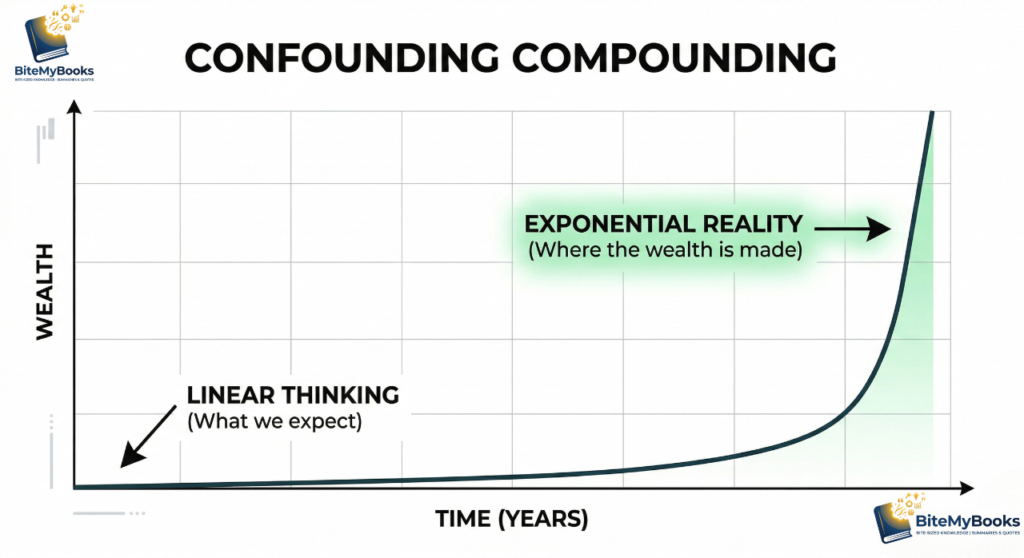
If compounding is the greatest wealth-building tool in history, why is everyone so bad at it? The answer is biological. Human brains are structurally designed to understand linear equations, not exponential ones.
If I ask you to calculate 8+8+8+8+8+8+8+8+8 in your head, you can logically work it out. The answer is 72. You understand that adding the same number sequentially creates a predictable, steady line.
But if I ask you to calculate 8x8x8x8x8x8x8x8x8, your brain breaks. The logical sequence fails you. (For the record, the answer is 134,217,728).
This is why we inherently ignore compounding in our personal finances. We instinctively assume that $10,000 invested today will grow in a neat, straight, predictable line. When the growth in the first five years feels slow and boring, we panic. We sell. We look for a faster moving asset.
- Linear thinking: You expect your money to double in five years. When it only grows 30%, you quit.
- Exponential reality: The real growth happens between years 20 and 30, assuming you never touched the principal.
- The Iceberg Effect: Like an iceberg, 90% of the massive wealth generated by compounding is completely hidden beneath the surface of time. You only see the tip.
Because we cannot intuitively visualize exponential growth, we drastically underestimate what our investments will be worth in 30 years. We interrupt compounding unnecessarily because we think it isn’t working fast enough.
Good Investing Isn’t About the Highest Returns
There is a dangerous, pervasive myth in the investing world. It is the belief that to get truly rich, you must beat the market by finding the next Apple or Bitcoin before anyone else.
You do not need to generate 30% annualized returns to build immense wealth. In fact, attempting to do so is the easiest way to go completely broke. Chasing the highest possible returns requires taking on catastrophic, existential risk.
The goal is not to have the best year ever. The true goal is to achieve “pretty good” returns that you can sustain uninterrupted for decades without getting wiped out.
If you aim for a sustainable 8% to 10% return, you can sleep at night. You can weather recessions. You won’t leverage your house to buy speculative assets. You simply stay in the game.
- Consistency over intensity: Earning an unbroken 8% over 30 years will crush earning 30% for three years followed by a 50% loss.
- The math of ruin: A 50% loss requires a 100% gain just to get back to breakeven. Avoid ruin at all costs.
- Survival is paramount: Your primary job as an investor is to ensure you never have to sell your assets during a market panic.
Compounding effectively acts as an unstoppable snowball. But a snowball only grows if it stays intact as it rolls down the hill. If you smash the snowball by taking reckless risks chasing higher yields, you have to start over at the top of the hill with a handful of snow.
The “Shut Up and Wait” Strategy
If time is the secret ingredient to compounding, then the hardest skill in finance is incredibly counterintuitive. The hardest skill is doing absolutely nothing.
When the market crashes 20%, every financial news anchor screams that the sky is falling. Your instinct is to sell your index funds to “protect” what you have left. In reality, you are interrupting the compound effect at the exact wrong moment.
Compounding only works if the money is left alone. It must be left alone during brutal recessions. It must be left alone during global panics. It must be left alone during long, boring, flat periods.
You cannot tinker with your portfolio every Tuesday and expect to build a fortune. Every time you buy and sell, you incur fees, taxes, and the opportunity cost of being wrong.
- Automate your contributions: Set up an automatic transfer to your brokerage account every single month.
- Delete the apps: Stop checking your retirement account balance every single day. The daily fluctuations are meaningless noise.
- Embrace boredom: Good investing is incredibly boring. It is the financial equivalent of watching paint dry or grass grow. If you want excitement, go to a casino.
“The first rule of compounding: Never interrupt it unnecessarily.” — Charlie Munger
Your Bite-Sized Action Plan
Reading about compounding is easy. Actually letting it happen is brutally difficult. It requires immense discipline, patience, and the emotional intelligence to ignore the noise. Here is your specific task for today.
🏆 The Ultimate Hack: Commit to a “hands-off” timeline for your current core portfolio.
Promise yourself, in writing, that you will not touch this money, sell it, or rebalance it aggressively for the next five years. Minimum.
Take 15 minutes right now to automate your investments. Set up a recurring transfer so that your money is invested on the 1st of every month before you ever see it in your checking account.
Remove the friction of decision-making. Stop trying to time the top or bottom of the market. Buy consistently, hold aggressively, and let the sheer, confounding mathematical weight of time do the heavy lifting for you.
FAQ
What is confounding compounding in the psychology of money?
Confounding compounding refers to the unintuitive, exponential mathematical growth of money over incredibly long periods of time. In The Psychology of Money, Morgan Housel explains that human brains drastically struggle to understand compounding because we think linearly. In reality, the vast majority of investment gains occur at the very end of a timeline, provided you never interrupt the growth.
How much of Warren Buffett’s wealth came after age 65?
Over $80 billion of Warren Buffett’s massive net worth was accumulated after his 65th birthday. While his stock picks are legendary, the true source of his wealth is sheer time. He began investing at age ten and allowed his portfolio to compound, entirely uninterrupted, for over 75 years.