📋 Chapter 3 at a Glance
- Core Framework: Every habit runs on a 4-step loop — Cue, Craving, Response, Reward.
- The Four Laws: Make it Obvious, Make it Attractive, Make it Easy, Make it Satisfying.
- The Inversion: Flip all four laws to destroy bad habits just as systematically.
- The Takeaway: You don’t need willpower. You need a system.
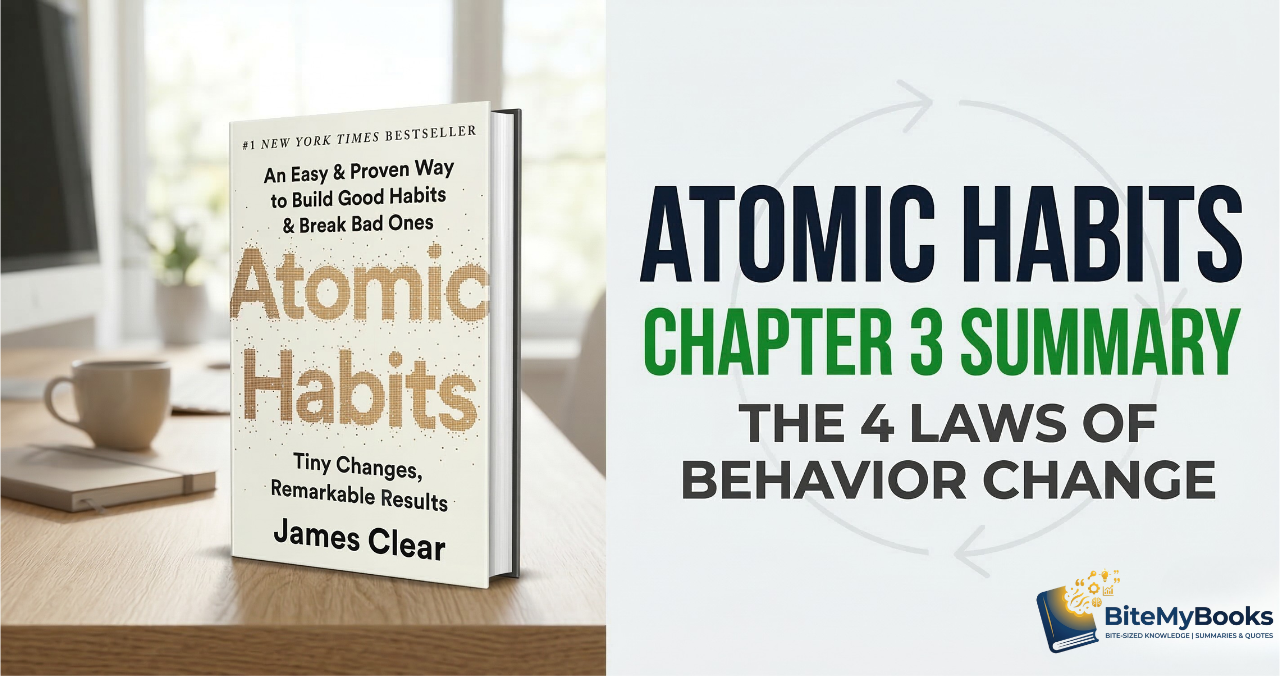
This Atomic Habits Chapter 3 summary is where James Clear stops being philosophical and starts being ruthlessly practical. If Chapter 2 was about who you need to become, Chapter 3 is about exactly how habits are built — at the neurological level — and the precise four-step system you can use to engineer them.
For a high-level overview of James Clear’s entire methodology, read our complete Atomic Habits Summary & Key Takeaways guide. If you haven’t read it yet, we highly recommend starting with our Atomic Habits Chapter 2 Summary to understand why identity must change before your habits do.
Chapter 3 gives you the blueprint. Let’s break it down.
📌 Jump To
The Habit Loop: Cue, Craving, Response, Reward
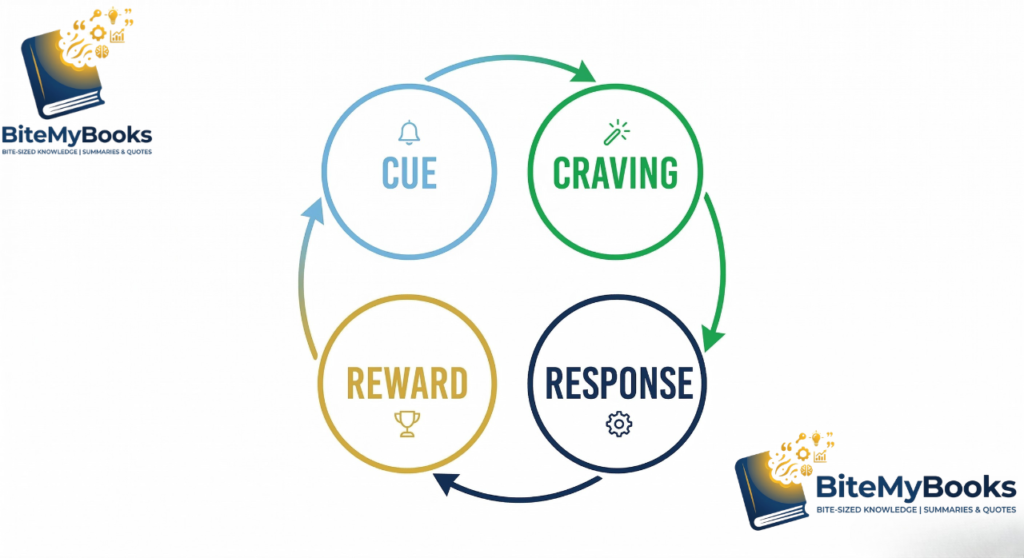
Your brain is a pattern-recognition machine. Every single habit you have — good or bad — runs on the same four-step neurological feedback loop, operating below your conscious awareness hundreds of times a day.
Clear breaks the loop down into four distinct stages:
- Cue: A trigger that tells your brain to initiate a behavior. It’s a piece of information that predicts a reward.
- Craving: The motivational force behind every habit. You don’t crave the habit itself — you crave the change in state it delivers.
- Response: The actual habit you perform — a thought, action, or behavior.
- Reward: The end goal of every habit. Rewards satisfy the craving and teach your brain that this loop is worth remembering.
Here’s how this plays out in real life every single morning:
☕ The Coffee Habit Loop
Cue: Your alarm goes off.
Craving: You feel groggy and crave alertness.
Response: You walk to the kitchen and make coffee.
Reward: The caffeine hits. You feel sharp and awake.
This loop runs automatically. You don’t decide to make coffee — your brain fires the sequence on autopilot. That is the power and the danger of habits: they run whether you design them or not.
Clear’s insight is simple but profound: if you understand the loop, you can engineer it. That’s exactly what the Four Laws are for.
The Four Laws of Behavior Change (How to Build Good Habits)
The habit loop is the theory. The Four Laws of Behavior Change are the practical toolkit. Each law maps directly onto one stage of the habit loop and gives you a concrete lever to pull.
🔑 The Four Laws — Quick Reference
- Law 1 → Make it Obvious (targets the Cue)
- Law 2 → Make it Attractive (targets the Craving)
- Law 3 → Make it Easy (targets the Response)
- Law 4 → Make it Satisfying (targets the Reward)
Law 1: Make it Obvious
You can’t act on a habit you don’t notice. The first step is to design your environment so the cue for a good habit is impossible to miss. Put your running shoes by the front door. Leave your book on your pillow. Place your vitamins next to the coffee machine.
Clear calls this environment design — and it is more powerful than motivation will ever be. When the cue is obvious, the habit becomes automatic.
Law 2: Make it Attractive
We act on habits we find appealing. The more attractive a habit is, the more likely we are to repeat it. Clear’s technique here is temptation bundling — pairing a habit you need to do with something you want to do.
For example: only listen to your favorite podcast while you exercise. The craving for the podcast pulls you to the gym. You’ve made the habit attractive.
Law 3: Make it Easy
The friction between you and a habit determines whether it happens. Reduce friction to near zero and the behavior becomes almost effortless. Prepare your workout clothes the night before. Sleep in your gym clothes if you have to. Pre-load the app, fill the water bottle, lay out the journal.
Clear introduces the Two-Minute Rule here: scale any new habit down to something that takes less than two minutes to start. “Read 30 pages” becomes “read one page.” Starting is everything.
Law 4: Make it Satisfying
The human brain prioritizes immediate rewards over delayed payoffs. If a habit doesn’t feel good in the moment, your brain won’t want to repeat it — regardless of its long-term benefits. Use immediate reinforcement: a habit tracker, a visual streak, a small treat after completing the behavior.
What is immediately rewarded gets repeated. What is immediately punished gets avoided. Design for the feeling, not just the outcome.
The Inversion of the Laws (How to Break Bad Habits)
The same framework works in reverse. To eliminate a bad habit, flip every single law on its head. Bad habits persist because they are easy, obvious, attractive, and satisfying. Your job is to systematically destroy each of those properties.
| Build Good Habits | Break Bad Habits |
|---|---|
| Make it Obvious | Make it Invisible |
| Make it Attractive | Make it Unattractive |
| Make it Easy | Make it Difficult |
| Make it Satisfying | Make it Unsatisfying |
- Make it Invisible: Remove the cue from your environment entirely. Delete the app. Don’t buy the junk food. Keep the TV remote in another room. Out of sight truly is out of mind.
- Make it Unattractive: Reframe the habit in your mind. Instead of “I can’t have a drink,” tell yourself “I don’t drink — it disrupts my sleep and kills my next-day performance.” Highlight the costs, not the pleasures.
- Make it Difficult: Add friction between yourself and the bad habit. Unplug your gaming console after each use. Put your phone in a drawer when you sit down to work. The extra steps create a moment of pause — and that pause is where willpower can act.
- Make it Unsatisfying: Create accountability. Tell a friend. Use a habit contract with consequences. When breaking a bad habit has a social or financial cost, your brain recalculates the reward equation.
⚡ Key Insight: You don’t break bad habits by relying on willpower. You break them by making them harder to execute than the alternative. Design the environment. The behavior follows.
Chapter 3 Bite-Sized Action Plan
Reading without acting is forgetting. Here is your one specific task for today — using Law 1: Make it Obvious.
🎯 Tonight’s Environment Design Challenge
- Choose one good habit you’ve been struggling to start (e.g., morning exercise, reading, journaling, drinking water).
- Tonight, physically alter your environment so the cue for that habit is the first thing you see tomorrow morning.
- Examples: Put your running shoes in front of your bedroom door. Place your journal on your pillow. Leave your water bottle on the kitchen counter. Put your book on top of your phone.
- When you wake up, the cue fires automatically. You don’t decide to build the habit — your environment decides for you.
That’s it. One physical change to your environment tonight. The habit follows tomorrow. This is how you stop relying on motivation and start relying on design.
Chapter 3 FAQ
What are the 4 Laws of Behavior Change in Atomic Habits?
The Four Laws of Behavior Change are: Make it Obvious, Make it Attractive, Make it Easy, and Make it Satisfying. Each law targets one stage of the four-step habit loop and gives you a concrete strategy for building a good habit. To break a bad habit, you invert each law: Make it Invisible, Unattractive, Difficult, and Unsatisfying.
What is the 4-step habit loop?
The 4-step habit loop is the neurological cycle that drives all human behavior: Cue → Craving → Response → Reward. The cue triggers the brain, the craving provides the motivation, the response is the action taken, and the reward reinforces the loop. Every habit — from checking your phone to going to the gym — follows this exact sequence automatically.
The Bottom Line on Chapter 3
Chapter 3 of Atomic Habits gives you the most important insight in behavioral science: you don’t rise to the level of your motivation — you fall to the level of your systems.
The habit loop is always running. The only question is whether you designed it — or whether it designed itself by accident. The Four Laws give you the tools to take control.
Ready to go deeper? Read our Atomic Habits Chapter 4 Summary next — where Clear breaks down the First Law in full detail and shows you exactly how to make your good habits impossible to miss.