

📋 Chapter 6 at a Glance
- Core Idea: Environment design is undeniably more powerful than sheer willpower or raw motivation.
- The Myth: “Disciplined” people simply structure their daily lives so they never have to use heroic self-control.
- The Reality: Visual cues aggressively dictate our behavior. If you change your immediate surroundings, you change your actions.
- The Rule: “One Space, One Use.” You must ruthlessly divide your physical rooms into hyper-specific action zones.
Most people severely overestimate the sheer power of motivation and dangerously underestimate the profound impact of their physical environment. They falsely believe that forcing a new habit requires a massive surge of heroic internal willpower to simply execute daily tasks. This is a critical, devastating mistake. Motivation is incredibly unreliable, but your physical surroundings exert a constant, invisible pressure on your behavior.
If you want to permanently change your life, you must stop trying to change your mind and start ruthlessly changing your room. Welcome to our definitive Atomic Habits Chapter 6 summary, where we completely expose the fatal flaw of relying on willpower and teach you how to engineer your surroundings for effortless success. By consciously upgrading your immediate environment, you forcefully eliminate the friction keeping you from your goals.
In the last chapter, we learned how to link behaviors together. If you missed it, read our Atomic Habits Chapter 5 Summary to master the Habit Stacking formula. For a complete masterclass on all of James Clear’s rules, bookmark our ultimate Atomic Habits Summary & Key Takeaways guide.
📌 Jump To
The Myth of Motivation and Discipline
Society incorrectly constantly praises highly successful individuals for possessing a massive abundance of raw discipline. We naturally assume that fit, productive, and wealthy people simply boast superior genetics that easily allow them to fiercely resist daily temptations. James Clear violently shatters this persistent illusion. The undeniable reality is far more practical and entirely within your absolute control.
The most “disciplined” people are simply individuals who are remarkably brilliant at actively structuring their daily lives. They intentionally engineer their immediate surroundings so they do not actually require heroic willpower or intense self-control. They fiercely eliminate negative temptations at the root source instead of trying to fight them.
If you constantly walk past a bowl of candy on your kitchen counter, you will eventually eat the candy when your willpower is depleted. The disciplined person does not awkwardly stand there fighting the urge. They simply refuse to keep the candy bowl anywhere inside their physical house.
💡 The Key Insight: Do not desperately try to increase your fragile willpower. Aggressively decrease the massive friction standing between you and the exact behavior you desire.
- Discipline is a rigid illusion: Highly successful people simply face far fewer daily environmental temptations than you do.
- Willpower is a rapidly depleting resource: Every single time you resist a bad habit, you biologically drain your remaining energy.
- Focus on the core system, not the fleeting symptom: Stop fighting toxic urges; completely remove the visual trigger creating the urge.
What is Choice Architecture?
Your daily behavior is not fundamentally determined by your hidden personality; it is essentially a direct function of you operating within your specific environment. This psychological concept is called Choice Architecture. It confirms that the specific items rapidly surrounding you aggressively dictate the immediate choices you forcefully make.
Of all your biological senses, your visual ability is undeniably the most powerful driver of human action. A massive portion of your brain is solely dedicated to processing visual information. Therefore, the specific visual cues vividly placed in your environment heavily dictate exactly what you will do next.
If you leave your smartphone actively sitting in the middle of your work desk, it serves as a massive visual cue to pick it up and scroll. You are unconsciously triggered to act simply because the item is visible. To permanently alter your behavior, you logically must alter what you visually perceive every single day.
| Core Strategy | Practical Example | Ultimate Result |
|---|---|---|
| Relying on Willpower | Keeping a guitar hidden in the closet, hoping you will blindly remember to play it. | Total failure. Out of sight entirely equals out of mind. |
| Choice Architecture | Placing the guitar precisely in the dead center of the living room. | High execution rate triggered by an undeniable visual cue. |
How to Design Your Environment for Success
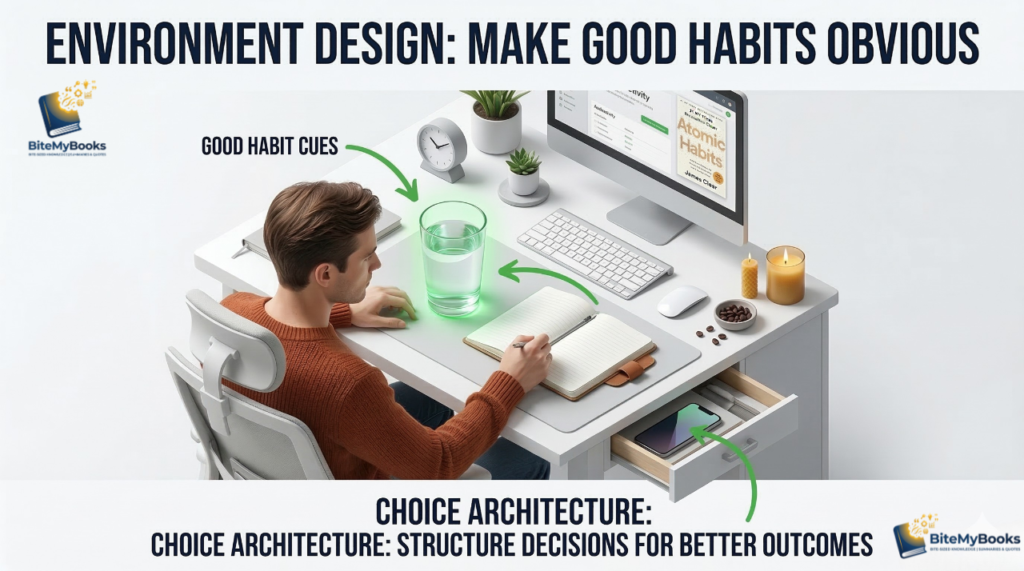
You must completely stop accepting the rigid default layout of your rooms and begin forcefully designing them to serve your goals. If you want a positive habit to accurately happen, you must make the visual cue to execute that habit unbelievably obvious. By deliberately hacking your surroundings, you make doing the right thing the path of least resistance.
Here are three undeniable ways to ruthlessly redesign your immediate workspace and home for maximum daily success:
- If you predictably want to drink significantly more water: Stop awkwardly relying on a single hidden cup. Aggressively fill up multiple large water bottles every morning and visually place them everywhere you sit—on your desk, your nightstand, and the coffee table.
- If you desperately want to practice playing the guitar: Never ruthlessly bury your heavy instrument inside a dark closet. Physically place the guitar securely on a highly visible stand in the exact middle of your living room so you literally cannot avoid staring at it.
- If you legitimately want to consistently read more books: Do not just lazily leave your iPad on the sofa. Purposely place a physical book aggressively on your bed pillow every morning so you are strictly forced to pick it up before you can safely fall asleep.
The entire objective is to successfully surround yourself with constant positive triggers. When your environment is expertly optimized, doing the remarkably hard thing oddly becomes your absolute easiest available option.
The “One Space, One Use” Rule
Context is arguably doing the heavy lifting in all human behavioral conditioning. When you casually execute multiple conflicting habits in the exact same physical location, your brain becomes incredibly confused. If you rigidly try to work from your comfortable bed, your brain violently confuses the powerful cue for “sleep” with the stressful cue for “work”.
To entirely solve this destructive mental confusion, James Clear intensely advocates for the “One Space, One Use” rule. You must rapidly divide your physical rooms into strictly specific, highly segregated action zones. The bed is explicitly for sleeping; the desk is explicitly for rigorous focus; the kitchen table is explicitly for eating.
🔑 The Ultimate Rule: Never mix the specific context of one crucial habit with another. When your context becomes horribly blended, the easier, lazier habit always immediately wins.
If you live entirely in a drastically small apartment, aggressively divide the physical space using rigid imaginary boundaries. Designate one specific chair exclusively for reading and absolutely nothing else. By firmly creating these strict physical definitions, stepping into a specific zone instantly triggers your brain into massive automatic action.
Chapter 6 Bite-Sized Action Plan
Your immediate surroundings are either intensely helping you or they are severely harming you; there is absolutely no neutral ground. At BiteMyBooks, we relentlessly demand that you stop reading and start executing right now. You must aggressively alter your physical environment tonight to guarantee an effortless victory tomorrow morning.
🎯 Your Accountability Task — Execute This Tonight
- Remove exactly ONE bad visual cue. Identify the biggest daily distraction in your workspace or bedroom. Immediately remove it. If your phone kills your focus, permanently charge it in a completely different room starting tonight.
- Add exactly ONE good visual cue. Identify the most vital positive habit you frequently skip. Immediately make it incredibly visible. If you want to swallow your daily vitamins, physically place the bottle aggressively exactly on top of your coffee maker tonight.
- Commit to the strategy. Stop pathetically blaming your lack of willpower. Intentionally design your physical environment to completely support your desired goals, making success the only visible path forward.
You are explicitly the architect of your own personal environment. If you continuously force yourself to operate in a completely chaotic, highly distracting space, you will always ultimately fail. Take total control over the objects immediately surrounding you, and you will undoubtedly take massive control over your entire future.
Chapter 6 FAQ
What is the main lesson of Atomic Habits Chapter 6?
The undeniable main lesson is that your immediate physical environment heavily matters exponentially more than your internal motivation. To permanently secure a powerful new habit, you strictly must strategically make the corresponding visual cues incredibly obvious and unavoidable. You successfully engineer your daily surroundings to completely eliminate friction for good habits while ruthlessly increasing friction for toxic ones.
What does James Clear say about environment design?
James Clear explicitly argues that highly disciplined people simply utilize expert environment design to heavily prevent ever needing heroic daily willpower. By intensely practicing choice architecture, you effectively make the difficult, right choices the absolute easiest available choices. Additionally, you must rigorously enforce the precise “One Space, One Use” rule to perfectly prevent dangerous, conflicting behavioral cues from destroying your focus.