Are you tired of setting goals that you never quite reach? You’re not alone. In James Clear’s groundbreaking bestseller, he reveals that the problem isn’t your motivation—it’s your system. If you want to transform your life, you need to understand the atomic habits key takeaways that make massive changes achievable through tiny, daily actions. In this guide, we’ll break down the core principles of the book so you can start building good habits and breaking bad ones today.
Don’t have time to read? Get the audiobook of Atomic Habits for FREE with an Audible trial.
The 1-Minute Executive Summary
If you only have a minute, here are the core takeaways from Atomic Habits:
- Habits are the compound interest of self-improvement. Getting 1% better every day counts for a lot in the long run.
- Forget about goals, focus on systems instead. Goals are about the results you want to achieve; systems are about the processes that lead to those results.
- Your habits shape your identity, and your identity shapes your habits. The most effective way to change your habits is to focus not on what you want to achieve, but on who you wish to become.
- The 4 Laws of Behavior Change offer a simple set of rules for creating good habits: Make it obvious, make it attractive, make it easy, and make it satisfying.
- Environment matters more than willpower. You can’t rely on self-control to change your life; you must design an environment that makes good habits inevitable and bad habits impossible.
The Core Concept: The Aggregation of Marginal Gains
The foundational idea of James Clear’s methodology is the concept of getting exactly 1% better every day. Most people overestimate the importance of massive, sweeping changes and underestimate the value of making small improvements consistently. Clear calls this the “Aggregation of Marginal Gains.”
If you can get 1% better each day for one year, you’ll end up 37 times better by the time you’re done. Conversely, if you get 1% worse each day for one year, you’ll decline nearly down to zero. What starts as a small win or a minor setback accumulates into something much more significant.
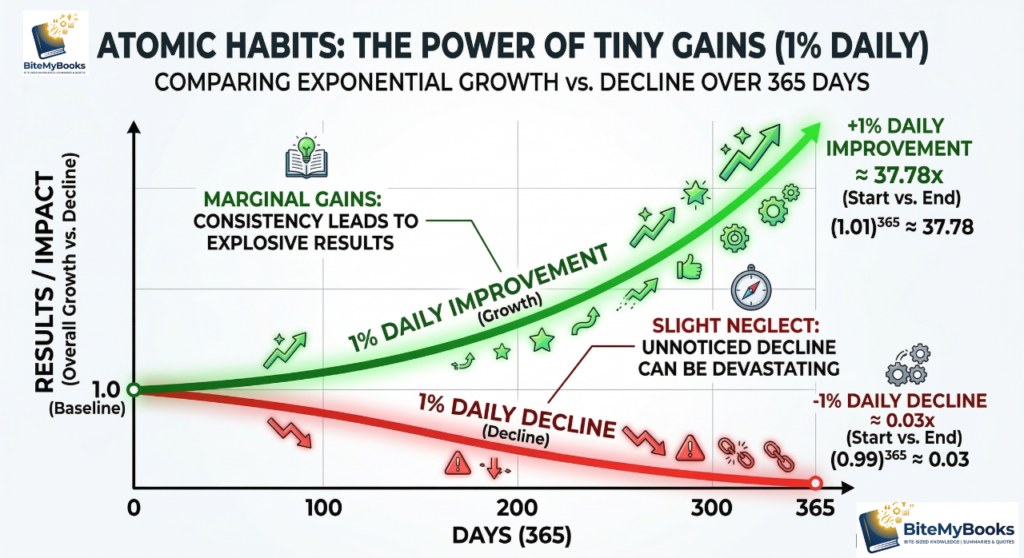
Your habits are practically invisible on a daily basis, but over months and years, they determine the trajectory of your life. Success is the product of daily habits—not once-in-a-lifetime transformations.
The 4 Laws of Behavior Change Explained
To build a habit that actually sticks, you need a framework. James Clear breaks down habit formation into four distinct steps: Cue, Craving, Response, and Reward. From these four steps, he derives the Four Laws of Behavior Change.
Law 1: Make It Obvious (The Cue)
Your brain is constantly analyzing your internal and external environment for hints of where rewards are located. The most common cues are time and location. To build a new habit, you must make the cue highly visible. For example, if you want to take vitamins every morning, put the pill bottle directly on top of your coffee maker.
Bite-Sized Action Plan: Use the Habit Stacking formula: “After I [CURRENT HABIT], I will [NEW HABIT].” (e.g., “After I pour my morning coffee, I will meditate for one minute.”).
Law 2: Make It Attractive (The Craving)
The more attractive an opportunity is, the more likely it is to become habit-forming. Habits are a dopamine-driven feedback loop. We are motivated to act by the anticipation of the reward, not just the fulfillment of it. To make a habit stick, you must pair an action you want to do with an action you need to do.
Bite-Sized Action Plan: Use Temptation Bundling. Only allow yourself to watch your favorite Netflix show (what you want) while you are walking on the treadmill or folding laundry (what you need to do).
Law 3: Make It Easy (The Response)
Human behavior follows the Law of Least Effort. We naturally gravitate toward the option that requires the least amount of work. To master a habit, you must reduce the friction associated with good behaviors. This is where the highly searched Two-Minute Rule comes into play. When you start a new habit, it should take less than two minutes to do. “Read before bed each night” becomes “Read one page.”
Bite-Sized Action Plan: Optimize your environment tonight. If you want to run tomorrow morning, lay out your workout clothes, shoes, and water bottle before you go to sleep.
Law 4: Make It Satisfying (The Reward)
We are more likely to repeat a behavior when the experience is satisfying. The human brain prioritizes immediate rewards over delayed rewards. To get a habit to stick, you need to feel immediately successful—even if it’s in a small way.
Bite-Sized Action Plan: Use a habit tracker. Crossing off a day on a calendar or filling a jar with marbles provides immediate visual satisfaction that you successfully completed your habit.
How to Break a Bad Habit (The Inversion of the 4 Laws)
If the 4 Laws are used to create good habits, you simply invert them to destroy bad habits. If you want to break a bad habit, follow these steps:
- Inversion of the 1st Law (Make it Invisible): Reduce exposure. Remove the cues of your bad habits from your environment. (e.g., Unplug the TV, delete social media apps from your phone).
- Inversion of the 2nd Law (Make it Unattractive): Reframe your mindset. Highlight the benefits of avoiding your bad habits.
- Inversion of the 3rd Law (Make it Difficult): Increase friction. Increase the number of steps between you and your bad habits.
- Inversion of the 4th Law (Make it Unsatisfying): Get an accountability partner. Ask someone to watch your behavior. The cost of a bad habit becomes painful if it is public.
Top 5 Quotes on Identity from Atomic Habits
True behavior change is identity change. Here are the most powerful quotes from the book regarding who you are becoming:
“Every action you take is a vote for the type of person you wish to become. No single instance will transform your beliefs, but as the votes build up, so does the evidence of your new identity.”
“You do not rise to the level of your goals. You fall to the level of your systems.”
“The ultimate form of intrinsic motivation is when a habit becomes part of your identity. It’s one thing to say I’m the type of person who wants this. It’s something very different to say I’m the type of person who is this.”
“Your identity emerges out of your habits.”
“True behavior change is identity change. You might start a habit because of motivation, but the only reason you’ll stick with one is that it becomes part of your identity.”
Ready to build better systems? Buy the physical copy of Atomic Habits here.
Frequently Asked Questions
What is the main point of Atomic Habits?
The main point of Atomic Habits is that tiny, incremental daily changes (atomic habits) compound into massive, life-altering results over time. Success comes from focusing on building efficient systems and shaping your deep identity, rather than just setting rigid goals.
How long does it take to read Atomic Habits?
The book is approximately 320 pages long, which takes the average reader about 5.5 hours to read cover-to-cover. If you are short on time, you can also listen to the audiobook on Audible during your daily commute.
What is the 2-minute rule in Atomic Habits?
The 2-Minute Rule states that any new habit should take less than two minutes to complete when you first start. Instead of trying to “read 30 pages a day,” your goal is simply to “read one page,” making the habit so easy you can’t say no.