

You can master the art of making cash, but if you lack the skills to keep it, you eventually end up broke. Getting wealthy vs staying wealthy is the ultimate financial dichotomy that derails most people. This is because the exact mindset required to obtain millions of dollars is the very mindset that will cause you to lose it all.
Getting wealthy involves taking massive risks, being relentlessly optimistic, and putting yourself completely out there. Staying wealthy requires the exact opposite approach entirely. Many self-made millionaires go completely bankrupt because they try to apply the skills that built their wealth toward the preservation of their wealth.
This survival mindset is one of the most crucial lessons from Morgan Housel. For a complete breakdown of his rules, read our ultimate The Psychology of Money Summary & Key Takeaways guide.
In our last post, we discussed Confounding Compounding and how time builds massive fortunes. But to let time work its magic, you must first survive.
- Building wealth requires extreme optimism and risk-taking. Keeping wealth requires paranoia and humility.
- The most important word in all of finance is “survival.” You just need to stay in the game long enough for compounding to work.
- A robust Margin of Safety (cash reserves) is what prevents a minor inconvenience from becoming a total financial disaster.
- You must develop a Barbell Personality: wild optimism for the next 20 years, paired with intense paranoia for the next 2 years.
The Two Different Mindsets: Optimism vs. Paranoia
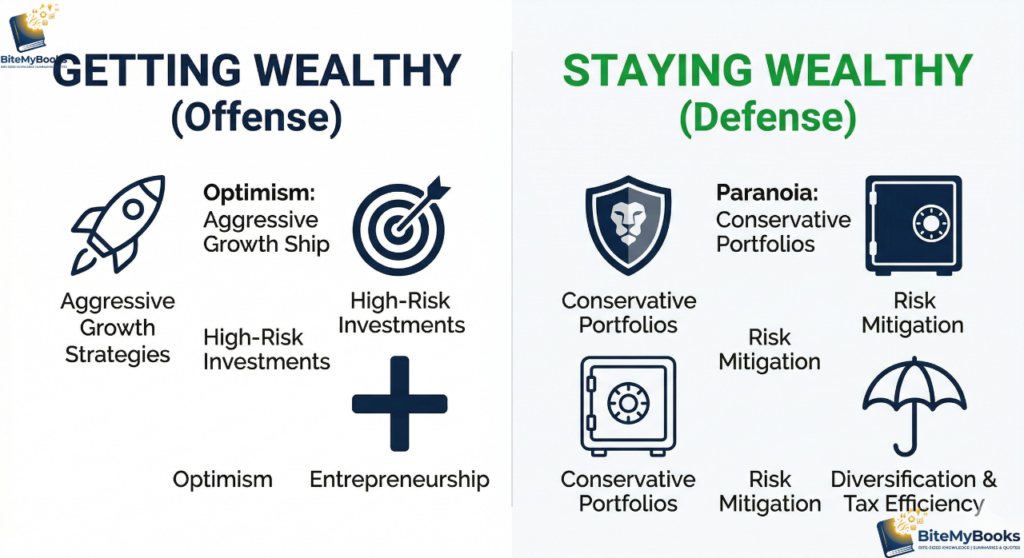
Getting wealthy requires a very specific psychological profile characterized by massive, unwavering optimism. You have to believe deeply that the future will be substantially better than the past. You must confidently take calculated risks, step outside your normal comfort zone, and aggressively pursue new financial opportunities.
You simply cannot build wealth without a degree of relentless forward momentum. This forward momentum forces you to invest capital in businesses, real estate, and stock markets even when the global news looks incredibly bleak. However, the exact personality traits that rocket you to the top of the financial ladder are rarely the ones that keep you securely anchored there.
Once you have built your wealth, the rules of the financial game fundamentally shift beneath your feet. Staying wealthy demands a remarkably heavy dose of pure paranoia.
You must logically assume that everything you have made can be taken away from you at a moment’s notice. The market absolutely does not care about your past success or your high IQ. A sudden global recession, a surprisingly bad investment, or an unforeseen personal life event can wipe out decades of intense, focused hard work.
- Getting wealthy is about deliberately seeking out high-reward risks.
- Staying wealthy is about aggressively mitigating those same risks to avoid ruin.
- Getting wealthy thrives on supreme, almost delusional levels of self-confidence.
- Staying wealthy thrives on deep, grounded humility and constant self-doubt.
To keep your money, you actively have to accept that a significant portion of your past success might have just been lucky timing. You must constantly realize that historical stock returns do not guarantee your future wealth. If you continue to swing for the absolute fences once you have already won the game, you risk striking out completely and losing everything.
The Art of Survival in Finance
The single most important word in the entire world of personal finance is not “returns,” “alpha,” or “leverage.” It is simply “survival.” It is the unglamorous ability to stay patiently in the game long enough for compounding interest to do its immensely heavy lifting.
Most novice investors mistakenly believe they need brilliant, market-crushing returns to build generational wealth. In reality, you just need consistently average returns delivered over a completely uninterrupted period of time. Interrupting your long-term compounding process is the deadliest, most unforgivable financial mistake you can possibly make.
Take Warren Buffett as the ultimate example of this survival principle. He is not widely considered the greatest investor in modern history simply because of his legendary stock-picking skills in a given year. He is the greatest because he has been investing consistently, without being completely wiped out, for roughly three-quarters of a century.
- Survival guarantees that you are still sitting at the table when the stock market eventually recovers from a catastrophic crash.
- Wiping out means you permanently lose your most valuable financial asset available: time on the market clock.
- Staying in the game prevents you from constantly resetting your financial progress back to zero.
If you take massive, highly leveraged risks in an attempt to boost your annual returns by an extra 2%, you are playing a fool’s game. Those same aggressive risks open your portfolio up to a 100% total loss during a severe market panic.
If you lose everything, you have completely failed the survival test and are removed from the game. The true goal is never to be the richest person by tomorrow afternoon. The goal is to ensure you are never forced to sell your solid, long-term investments during a sudden financial crisis.
Room for Error (The Margin of Safety)
No matter how flawlessly constructed your spreadsheets are, the future remains entirely unpredictable. Reality will consistently throw a wrench directly into your perfectly optimized financial models. This is precisely why you must deliberately build a massive margin of safety heavily into your personal financial life.
A margin of safety is simply the engineering concept of leaving ample “room for error.” If your specific financial retirement plan strictly requires the stock market to perform absolutely perfectly over the next ten years, your plan is incredibly fragile and guaranteed to break. If you require an unbroken streak of economic success just to barely survive, you are dangerously living on borrowed time.
How exactly do you go about creating this necessary room for error in your own life? You do it by hoarding cash and fiercely avoiding unnecessary debt leverage.
- Cash is your financial oxygen. Maintaining a robust, liquid emergency fund ensures you never have to panic-sell your index funds down 30% just to cover your monthly mortgage payment.
- Leverage is financial poison. Taking on debt mathematically magnifies your potential gains, but it ruthlessly magnifies your downside losses in equal measure.
- Debt actively removes your room for error and fully transfers control of your timeline directly into the hands of a bank.
You must actively plan for your perfectly laid plan to completely fail to go according to plan. That is the cornerstone of robust financial resilience. You desperately need enough financial shock absorbers in place to calmly handle massive medical emergencies, sudden corporate layoffs, or an entire decade of completely stagnant stock market returns.
The Barbell Personality
To successfully navigate the treacherous transition between getting wealthy and staying wealthy, you must actively develop a psychological split personality. Morgan Housel elegantly refers to this incredibly unique trait as having a “barbell personality.”
You need to intensely balance extreme, unwavering long-term optimism with heavily scrutinized, short-term paranoia. You cannot sustainably survive the financial markets if you completely lack either one of these highly opposing mindsets.
On one heavy end of the barbell, you absolutely must remain deeply optimistic about the long-term future of humanity. You must sincerely believe that over the next 20, 30, or 40 years, human innovation and corporate productivity will violently drive the global economy forward to new heights. This deep long-term optimism is the singular force that gives you the raw courage to buy and eternally hold broad index funds through turbulent decades.
However, on the exact opposite end of that same barbell, you must remain incredibly paranoid about the immediate short-term future. You must operate your daily life assuming that the next two to three years could be an absolute economic disaster filled with inflation and job loss. This rigid short-term paranoia is exactly what forces you to maintain a bulky cash emergency fund and ruthlessly avoid reckless consumer debt.
- Long-Term Optimism: Allows you to permanently capture the massive upside of global economic growth and compounding dividends over a lifetime.
- Short-Term Paranoia: Keeps you safely out of bankruptcy court when the wildly inevitable banking crises, corporate layoffs, and global pandemics suddenly strike without warning.
Focusing purely on optimism without any degree of paranoia leads swiftly to financial ruin when the bubble pops. Focusing purely on paranoia without holding any optimism leads to devastatingly missed investment opportunities over your lifetime. You must learn to permanently hold both highly conflicting ideas in your mind actively at the exact same time.
Your Bite-Sized Action Plan
Reading about the concept of financial survival is entertaining and easy. Actually preparing your personal finances for an impending disaster requires highly deliberate action. Your specific task for today is to aggressively audit your exact margin of safety.
You urgently need to know exactly how much room for error you currently possess right now. Do not just roughly estimate or guess your accounts from memory. Sit down at your computer and ruthlessly calculate the hard, verifiable numerical data today.
🎯 Action Steps to Audit Your Margin of Safety:
- Audit Your Liquid Cash: Log directly into all your bank accounts and meticulously tally up your liquid cash. Exactly how much money is sitting completely safe in FDIC-insured high-yield savings accounts?
- Calculate Your True Runway: Add up your absolute bare-minimum monthly living expenses (rent, groceries, basic utilities, required insurance). Aggressively divide your total emergency cash pile by this monthly survival number.
- Assess the Final Result: Do you possess exactly 3 months of survival runway? Do you have 6 months? Are you protected for an entire calendar year?
If your calculated survival runway is dangerously less than 6 whole months, you need to firmly hit the brakes and pause your aggressive, risk-heavy investing schedule immediately. Fiercely redirect your monthly capital towards rapidly building your liquid cash reserves until you have forged a rock-solid, impenetrable margin of safety.
FAQ
What is the difference between getting wealthy and staying wealthy?
Getting wealthy requires immense optimism, huge risk-taking, and aggressively pushing past boundaries to accumulate capital. Staying wealthy is the complete opposite, requiring intense paranoia, profound humility, and a heavy focus on risk mitigation. You must avoid catastrophic financial losses at all costs to let compounding work.
Why is staying wealthy so difficult?
Staying wealthy is incredibly difficult because you must completely unlearn the hyper-aggressive skills that originally made you rich. The stock market does not care about your past success or previous huge wins. A single bad bet or massive over-leveraging event can instantly eliminate decades of careful wealth building.