
Here is one of the most uncomfortable truths in personal finance: we spend fortunes on things designed to impress people who are too busy thinking about themselves to notice. This is the essence of the man in the car paradox — and once you see it, you cannot unsee it.
The paradox exposes a massive flaw in how most people think about money, status, and success. We buy things to signal our worth to the world, only to discover the world is looking right past us.
This concept is one of the most powerful lessons from Morgan Housel. For a complete breakdown of his rules for financial freedom, read our ultimate The Psychology of Money Summary & Key Takeaways guide.
- When people see a luxury car, they imagine themselves driving it — not the actual driver.
- Buying expensive things to earn respect is a losing game — onlookers use your wealth as a benchmark for their own desires.
- Status is visible spending. Wealth is invisible saving.
- Real admiration is earned through humility, kindness, and competence — not credit card limits.
What is the Man in the Car Paradox?
Morgan Housel introduced this concept in The Psychology of Money with a simple but devastating observation. When you see a stunning, gleaming Ferrari roar past you on the street, what do you actually think?
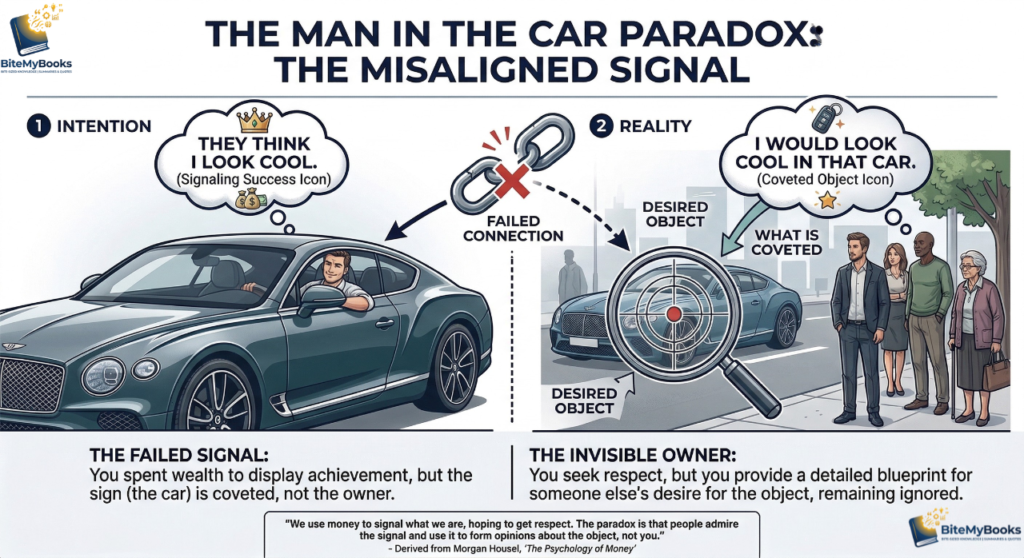
You don’t think, “Wow, that driver must be impressive.” You think, “Imagine if that were me behind that wheel.” You admire the car. You imagine yourself in it. You forget the driver entirely.
And here is the brutal paradox: the driver bought that car precisely because they thought people would admire them. But the admiration flows to the car, not the person. The driver is invisible.
- The driver’s goal: earn admiration and signal success.
- The spectator’s actual reaction: project their own desires onto the car.
- The result: the driver spent six figures and got zero of what they were actually after.
Housel’s point is not that luxury cars are bad. His point is that if your primary motivation for a purchase is the reaction of other people, you are operating on a broken assumption.
The Illusion of Wealth and Respect
This paradox plays out everywhere — not just on the highway. The designer handbag. The sprawling suburban McMansion. The first-class seat. The Rolex. All of them are purchased, at least in part, to communicate something to other people.
The problem is that wealth is a spectacularly poor vehicle for earning genuine respect. When people see someone with obvious money, they don’t think, “I deeply admire that person.” They think, “I’d like to have that myself.”
Your possessions become a benchmark against which others measure their own desires — not a trophy they award you for being impressive. The respect you were chasing goes to the object, not to you.
- People see your big house and think: “I want a house like that.”
- People see your luxury watch and think: “I should get one of those someday.”
- People see your business class upgrade and think: “That looks comfortable.”
Nobody is sitting there crafting a detailed mental portrait of you as a successful, praiseworthy human being. They’re thinking about themselves. We all are. It’s just how the human brain works.
The Difference Between Wealth and Status
This is where Housel draws one of the most important distinctions in personal finance: wealth and status are not the same thing. In fact, in many cases, they pull in opposite directions.
Status is visible. It’s the $100,000 sports car in the driveway, the designer clothes you wear, the restaurant you’re seen at. Status spending is performative — it’s money deployed as a public announcement.
Wealth is invisible. It’s the $100,000 sitting quietly in an index fund, compounding month after month, that no one can see and no one talks about at dinner parties.
“Wealth is what you don’t see. It’s the cars not purchased, the diamonds not bought, the renovations postponed, the clothes forgone.” — Morgan Housel, The Psychology of Money
The paradox gets cruel here: the more aggressively you spend on status symbols, the less wealth you actually accumulate. You end up looking rich while becoming poorer. Someone with a modest car and a fat investment account has more freedom, more security, and more options — they’ve just chosen to keep it private.
- Status spending: Buy the $100K car → Have $100K less + depreciation.
- Wealth building: Invest $100K → Have $100K more + compound growth.
- The irony: The wealth-builder has far more real power, but zero of the visible status.
The hard question Housel forces us to ask is this: Are you building wealth, or are you performing it?
How to Escape the Paradox (Humility Over Horsepower)
Here’s the good news: the exit ramp from this trap exists, and it doesn’t cost $100,000. If you want genuine respect and admiration, you cannot buy it at a dealership. You earn it.
The people who command deep, lasting respect in any room are almost never the ones with the most expensive items. They’re the ones who are genuinely interested in others, generous with their knowledge, and consistent in their values.
Think about the most respected people in your own life. Were they impressive because of what they drove? Or were they impressive because of how they made you feel, how they solved problems, and how they showed up when it mattered?
- Humility: Listening more than you talk. People remember how you made them feel, not what you wore.
- Kindness: Acts of generosity are the most memorable status signals of all — and free.
- Competence: Being genuinely exceptional at something earns more lasting admiration than any trophy purchase.
- Reliability: Doing what you say you’ll do, every time. This is rarer and more impressive than any car.
The shift is simple but requires real honesty with yourself: stop trying to signal success to strangers, and start building it in private. The people who matter will notice — and they’ll respect you for the right reasons.
Your Bite-Sized Action Plan
One task. Do it today. No procrastination.
🎯 Today’s Action: The Status Audit
Pick one expensive item you already own — or one big purchase you’re currently planning. Then ask yourself these three brutally honest questions:
- Would I still want this if no one could ever see it or know I owned it?
- Is this purchase solving a real problem in my life, or am I buying a signal?
- Who exactly am I trying to impress — and do I actually care about their opinion?
If the honest answers don’t line up with your reasons for buying, that’s your man in the car paradox moment. The purchase is not for you. It’s a performance with an audience that isn’t watching.
This doesn’t mean never spend money on things you enjoy. It means spend deliberately, on things that generate real value in your life — not borrowed status from strangers.
Redirect even $200 a month from performative spending into an investment account. Over 20 years at a 7% average return, that’s over $100,000 in real, invisible, compounding wealth — which ironically is more impressive than almost any status symbol you could have bought with it.
FAQ
What is the man in the car paradox in the psychology of money?
The man in the car paradox is Morgan Housel’s observation that when people see a luxury car, they don’t admire the driver — they admire the car and imagine themselves driving it. The driver bought the car expecting admiration but receives none, because observers project their own desires onto the object rather than respect onto the person. It illustrates why wealthy possessions are a poor substitute for genuine respect.
Does buying luxury items bring respect?
Not in the way most people expect. Luxury items attract attention to themselves, not to the person who owns them. Onlookers simply use expensive possessions as a benchmark for their own desires. Lasting, genuine respect is earned through humility, reliability, and competence — none of which can be purchased, and all of which are far more memorable than the car in your driveway.