
📋 The Psychology of Money — At a Glance
- Core Thesis: Doing well with money is less about intelligence and more about behavior.
- Author: Morgan Housel — former Wall Street Journal columnist and partner at Collaborative Fund.
- The #1 Insight: Your relationship with money is shaped by when and where you grew up, not by IQ.
- The Ultimate Secret: Compounding. Warren Buffett made 99% of his wealth after age 50.
- The Critical Distinction: Rich is visible. Wealthy is hidden — and hidden is what gives you freedom.
Most people think building wealth is about knowing the right stocks, reading financial statements, or finding the perfect investment formula. Morgan Housel’s landmark book destroys that myth in the very first chapter. This Psychology of Money summary will show you why doing well with money has almost nothing to do with intelligence — and everything to do with how you behave.
Building long-term wealth requires impeccable daily routines. Before you master your money, make sure you read our ultimate Atomic Habits Summary & Key Takeaways guide to master your behaviors first.
Housel’s book is not a manual on stock-picking or budgeting hacks. It is a deep, honest exploration of the emotional, psychological, and behavioral forces that determine who gets rich, who stays rich, and who destroys their own wealth — even when they should know better. The lessons are timeless, universal, and deeply uncomfortable in the best way.
📌 Jump To
Why Financial Success is a Soft Skill
In school, we are taught finance like it is physics. There are formulas, laws, and rules that always work the same way in every situation. Apply the right formula, get the right answer. Housel argues this entire framework is dangerously wrong.
Finance does not behave like physics. It behaves like psychology. It is driven by fear, greed, ego, overconfidence, and hope. Two people with identical incomes and identical knowledge can make completely opposite financial decisions — and both feel completely rational doing it.
The engineer next door who quietly built a $4.7 million portfolio while earning a modest salary is not smarter than the high-earning surgeon who is broke at sixty. The engineer just behaved better, consistently, over time. That is the entire thesis of this book.
💡 Housel’s Core Argument: “The finance industry talks too much about what to do, and not enough about what happens in your head when you try to do it.” Soft skills — patience, humility, and long-term thinking — beat technical knowledge every time.
- Technical knowledge is a commodity: Anyone can Google a P/E ratio. Very few people can hold a stock through a 40% crash without panic-selling.
- Behavior compounds over decades: Good financial behavior, repeated consistently for 30 years, outperforms any genius short-term strategy.
- Emotions are the enemy: The market rewards the patient and punishes the reactive — regardless of IQ.
Top 5 Key Takeaways from The Psychology of Money
Housel packs 20 chapters of dense, real-world financial wisdom into a book you cannot put down. These are the five chapters that will permanently change how you think about money, risk, and wealth. Read all five. Implement at least one today.
1. No One’s Crazy
Every financial decision you make feels completely rational — from your own vantage point. But your vantage point is entirely shaped by the generation and economy you grew up in. It is not shaped by textbooks or objective data.
A person who grew up during the Great Depression has a completely different relationship with cash, risk, and spending than someone who grew up in the booming 1990s bull market. Neither is irrational. They are both responding logically to the financial reality they personally experienced.
This is why your parents drive you crazy about money. This is why your financial advisor confuses you. No one is crazy — everyone is just working with a different set of lived experiences. Understanding this makes you less judgmental and a far better financial decision-maker.
2. Luck and Risk
Luck and risk are two sides of the same coin, and we chronically underestimate both. When someone succeeds, we attribute it to skill, hard work, and brilliance. When someone fails, we attribute it to laziness or poor choices. We are almost always partially wrong on both counts.
Bill Gates attended one of the only high schools in the world — out of roughly 303 million high school–age students globally at the time — that had a computer. His friend Kent Evans, equally brilliant and equally hardworking, died in a mountaineering accident before he could co-found Microsoft. Luck gave Gates a path. Risk took Evans off his.
This does not mean effort is irrelevant. It means you should be humble about your own success and compassionate about others’ failures. Not all poverty is laziness. Not all wealth is genius. Calibrate accordingly.
3. Never Enough
The most dangerous financial disease is not poverty. It is the inability to define “enough.” Housel uses the cautionary story of Rajat Gupta — the Goldman Sachs board member worth hundreds of millions of dollars who risked his career, freedom, and legacy for insider trading. For more money he did not need.
Bernie Madoff built a legitimate, highly profitable business on Wall Street. He did not need to run a $64 billion Ponzi scheme. But the goalpost kept moving. More was never enough. The pursuit of “more” at any cost destroyed everything he had built — and devastated thousands of victims in the process.
⚠️ Housel’s Warning: “The hardest financial skill is getting the goalpost to stop moving.” If you cannot define enough, no amount of money will ever feel sufficient. You will keep taking unnecessary risks until something breaks.
The antidote is stark simplicity: write down your “enough” number today. The exact dollar amount that would give you freedom, security, and peace of mind. Then — and this is the hard part — protect it fiercely when you reach it.
4. Confounding Compounding
Warren Buffett is almost universally considered the greatest investor in history. But Housel makes a provocative argument: Buffett’s real superpower is not stock-picking — it is time.
Buffett started investing seriously at age 10. His net worth at age 30 was approximately $1 million. At 50, it was approximately $300 million. Today, his net worth exceeds $100 billion. He made more than 99% of his total wealth after his 50th birthday. Not because he got smarter, but because compounding had more time to run.
| Warren Buffett’s Age | Approximate Net Worth | Key Lesson |
|---|---|---|
| Age 30 | ~$1 million | Compounding is just beginning. |
| Age 50 | ~$300 million | Decades of patience are paying off. |
| Age 90+ | $100+ billion | 99% of his wealth was built after age 50. |
The critical takeaway: compounding is not exciting to watch. That is precisely why most people miss it. They quit too early, chase faster returns, or spend the principal. The investors who simply stay in the game — without interruption, for decades — win by a staggering margin.
5. Getting Wealthy vs. Staying Wealthy
Building wealth and preserving wealth require completely opposite mindsets. Getting wealthy demands risk-taking, optimism, and a willingness to put yourself out there. You must bet on yourself. You must tolerate uncertainty. You must believe things will go right.
Staying wealthy demands the exact opposite: paranoia, frugality, and a deep respect for how quickly everything can disappear. The people who blow up financially after achieving success are almost always the ones who kept acting like they were still in “get rich” mode when they should have shifted into “stay rich” mode.
- Getting Wealthy: Take bold risks. Be optimistic. Make asymmetric bets. Grow aggressively.
- Staying Wealthy: Avoid ruin. Build margins of safety. Spend less than you earn. Never bet everything.
- The Shift: Most people never consciously make this switch — and that is why most financial horror stories involve people who were once very successful.
The Difference Between Being Rich and Being Wealthy
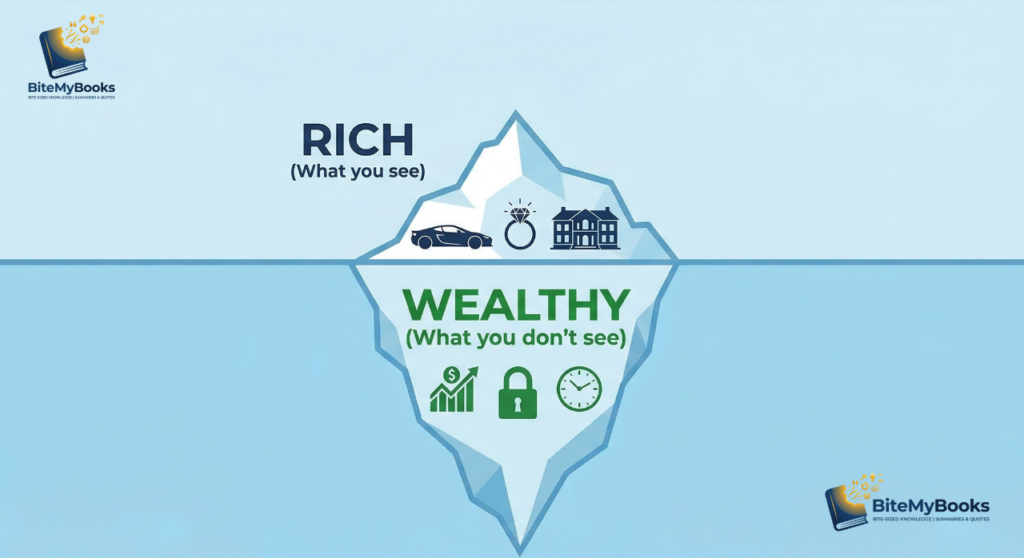
This is one of the most counterintuitive — and liberating — distinctions in the entire book. In everyday language, people use “rich” and “wealthy” as synonyms. Housel argues they are fundamentally, dangerously different things.
Being rich is visible. It is the $150,000 car parked in the driveway. The designer wardrobe. The first-class flights and the Instagram-worthy vacation house. Rich is what other people can see. And here is the critical insight: most visibly rich people are spending their income as fast — or faster — than it arrives. Their lifestyle depends on the next paycheck.
Being wealthy is invisible. Wealth is the money you chose not to spend. It is the investments, the index funds, the emergency fund, the retirement account quietly compounding in the background. You cannot see real wealth because it intentionally does not look like anything. Wealth gives you the one thing money truly buys: control over your time.
🔑 The Core Distinction: The person driving a beat-up car and living in a modest house with $2 million invested is wealthier — and freer — than the executive living in a million-dollar home with $0 saved. Never confuse the appearance of wealth with actual wealth.
The practical implication is profound. Stop spending money to signal status to people who, as Housel bluntly puts it, are not actually thinking about you anyway. Every dollar you save and invest is a unit of future freedom. That is worth more than any visible symbol of success.
The Psychology of Money Action Plan
Reading without action is just expensive entertainment. Here are two concrete things you will do today — not someday, not when you feel ready, but today — to start applying the most important lessons from this book.
🎯 Your Two Non-Negotiable Actions — Do These Today
- Define your “enough” number. Open a notes app right now. Write down the exact dollar number — in your investment account, not your salary — that would give you genuine financial freedom and peace of mind. Not the number that would impress others. Your actual number. This single act of clarity will protect you from a lifetime of goalpost-chasing.
- Automate a $50 monthly investment today. Log into your brokerage or retirement account and set up a recurring $50 automatic investment into a broad index fund. This is not about the $50 — it is about starting the habit of automatic, consistent investing so that compounding can begin as early as possible. The exact amount matters far less than the consistency and the starting date. Today beats next month by decades of compounding.
These two actions cost you nothing but ten minutes. They will, over time, be worth more than any stock tip, financial course, or get-rich-quick scheme you will ever encounter. Morgan Housel’s entire book ultimately comes down to this: behave well, consistently, for a very long time.
FAQ
What is the main message of The Psychology of Money?
The main message of The Psychology of Money is that financial success is not determined by intelligence or technical knowledge — it is determined by behavior. Morgan Housel argues that patience, humility, and the ability to avoid catastrophic mistakes over long periods of time matter far more than finding the perfect investment strategy.
What is the difference between rich and wealthy?
Being rich means having a high income or visible, expensive possessions — things others can see and admire. Being wealthy means having assets and investments that generate freedom and security, even if they are completely invisible from the outside. True wealth is the money you choose not to spend — and that hidden pile is what gives you ultimate control over your own time.